LLM Testing: Introduction to Large Language Model Testing
Large Language Models (LLMs) have become a core component of Generative AI applications, powering everything from chatbots and virtual assistants to content generation tools and business automation systems. Unlike the traditional software that people are familiar with, systems equipped with LLM may generate completely different outputs even when they receive nearly identical inputs. This fundamental difference drastically increases the difficulty of testing: testers not only need to verify that the application can run normally without functional failures, but also check whether the generated responses are accurate, align with the questions raised by users, carry non-compliant security risks, or produce inconsistent answers to the same type of question across multiple outputs. Through a dedicated set of methods, LLM Testing helps developers systematically identify hidden problems in applications powered by large language models.
LLM Testing: What Is LLM Testing?
Fundamentally, LLM Testing is the complete process of evaluating all applications that use large language models to generate and process information. Its goal is to confirm that the model itself, as well as the entire application built around it to operate in tandem, can function as expected by developers across various scenarios.
When testing traditional software in the past, the logic was usually straightforward: a test passed as long as the actual output matched the pre-defined unique correct answer. But this is completely different for LLM applications. The same question may have multiple valid responses, with no single absolute standard answer. Therefore, testers cannot only check whether the output text perfectly matches a preset answer; they must comprehensively evaluate the quality and various characteristics of the response.
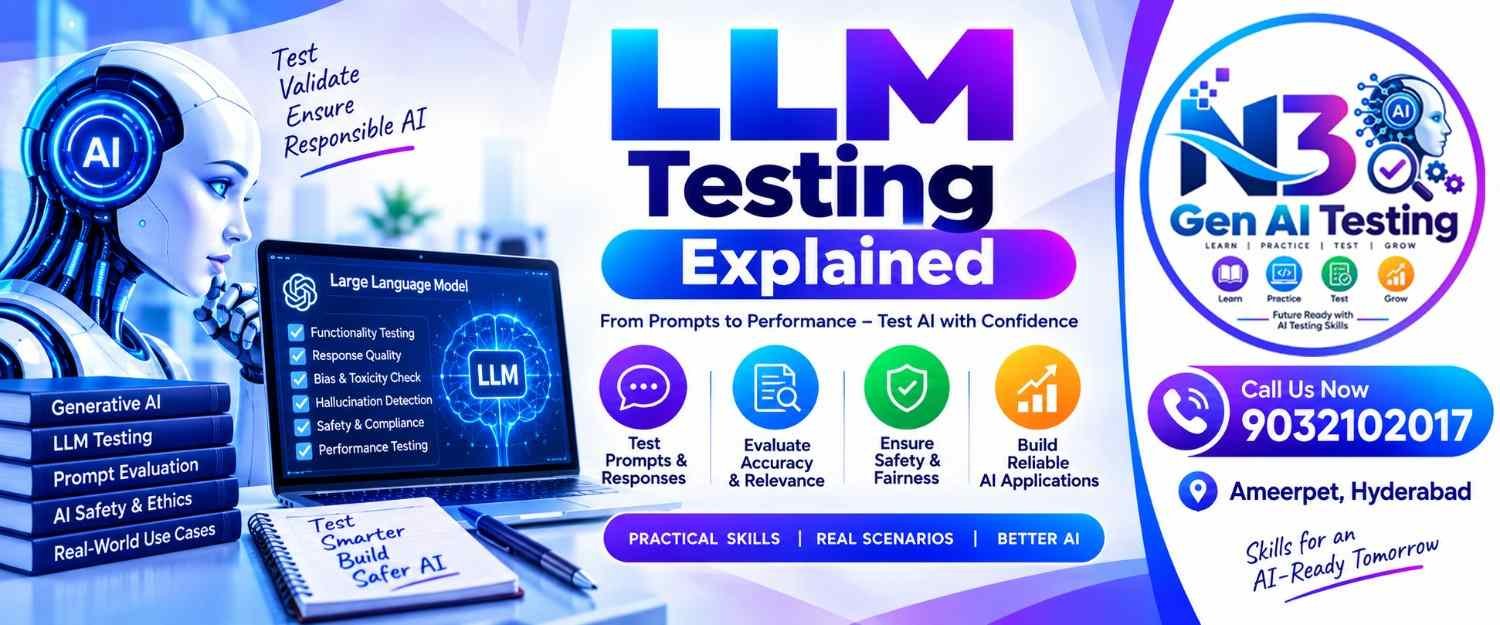
LLM testing requires assessing a series of core metrics: response accuracy, relevance to the question, information completeness, output consistency, context comprehension ability, instruction execution ability, absence of hallucinations, compliance with safety requirements, and the response’s performance.
LLM Testing: Importance and Common Testing Scenarios
Many enterprises initially underestimate the cost of skipping rigorous LLM testing. The responses generated by LLM may seem logically coherent and professionally expressed, but they can hide incorrect, incomplete, or unfounded content. If businesses use such AI in customer service, operations, software development, or other high-stakes work, these minor issues can escalate into very serious incidents, causing irreversible losses to the enterprise.
Conducting formal LLM testing helps enterprises detect all kinds of problems with the model before users encounter them, and continuously verify that the application always operates as required, with all generated responses meeting preset quality standards.
To cite an example mentioned in the original text: a chatbot built for a company to answer product questions must only output relevant information from officially approved sources. If it fabricates content that does not exist in the company’s knowledge base, such as making up a non-existent product parameter or service rule, testers must identify this problem and report it for repair in accordance with procedures.
LLM Testing: Common LLM Testing Scenarios
A reliable LLM testing solution must incorporate different types of test inputs, and cannot rely solely on conventional questions to conduct tests. Testers can start with the most common regular questions, then gradually add more complex or unexpected edge scenarios that no one would think someone would ask, covering all possible situations the model may encounter.
Common test scenarios include:
- Asking simple questions
- Asking complex compound questions
- Submitting vague and unclear requests
- Providing incomplete inputs with missing information
- Testing long-form multi-turn conversations
- Inputting erroneous and misleading information
- Repeatedly asking the same question
- Presenting conflicting and contradictory instructions
In addition to these conventional abnormal scenarios, testers must additionally verify how the model reacts when it does not have enough information to answer a question. In accordance with the application’s design requirements, it must never fabricate unfounded content to fool users, and must handle this information-deficient scenario in line with preset rules, such as honestly telling the user “I cannot answer this question at the moment.”
For conversational applications specifically designed for chatting, context testing is particularly critical. Testers can have several consecutive rounds of conversation with the application, embedding previously mentioned needs and prior information in the dialogue, to check whether it can correctly understand all previous content, retain the relevant context throughout, and avoid forgetting earlier conversational premises to the point of answering irrelevantly.
LLM Testing: Accuracy, Hallucination, Automation and Best Practices
Evaluating the overall quality of responses is one of the core differences between traditional software testing and LLM testing. Before formally running all test scenarios, testers can first define clear evaluation criteria for each item to avoid vague subjective judgments during testing.
Key areas to evaluate include:
- Accuracy
- Relevance
- Clarity
- Completeness
- Consistency
- Context comprehension ability
If the application uses Retrieval-Augmented Generation (RAG), testers must also conduct additional checks to verify that the system can retrieve appropriate relevant information from the knowledge base, and correctly apply that retrieved information when generating responses, avoiding scenarios where it searches for the wrong information or fails to use the retrieved information correctly.
Testers can create their own test dataset containing various typical questions that cover the vast majority of scenarios users would normally ask, then repeatedly use this fixed set of data to evaluate the model’s performance. By comparing the test results of different versions of the model, it is possible to intuitively see whether the model has improved through iteration, or whether it has regressed in ways never encountered before—for example, failing to answer a question it previously answered correctly after a model update.
LLM Testing: Hallucination, Safety and Automation
Evaluating Hallucinations and Safety Risks
Testing for hallucinations is a critical part of LLM testing. A hallucination refers to the AI system generating inaccurate, unfounded information and presenting it as factual, making it impossible for ordinary users to distinguish it from the truth.
Testers can specifically design scenarios where the model lacks enough information to answer—such as asking an obscure question that the knowledge base does not contain—to see whether it will output made-up responses or inform the user that it cannot answer.
In addition to hallucination testing, safety testing is also indispensable. Testers must check for potential risks such as prompt injection, instruction manipulation, and unauthorized disclosure of non-public information, and must never allow generated responses to expose sensitive content such as the enterprise’s internal data or users’ private information.
Balancing Manual and Automated Testing
Manual testing is suitable for evaluating the flexible performance of conversational applications and special responses with complex logic, as human subjective judgment can catch problems that machines are likely to miss. However, using automation for repetitive, standardized tests is far more efficient.
An automated test suite can run a large number of questions at once, eliminating the need for testers to manually input them one by one, and can also batch-evaluate generated responses according to pre-defined standards, freeing up time to handle more complex test scenarios.
Test automation also supports regression testing: whether developers modify the underlying model, hardcoded question content, the application’s business logic, or the supporting knowledge base data, testers can rerun all previously tested scenarios to identify unforeseen problems resulting from the changes.
Combining manual evaluation with automated testing not only covers more test content—ensuring teams do not miss complex scenarios requiring human judgment—but also reduces the meaningless workload of repeating tests, maximizing testing efficiency.
Implementing an Effective Testing Strategy
To implement an effective LLM Testing process, you must first clearly define the testing objectives before starting work blindly, and prepare representative test scenarios that cover the vast majority of situations users will encounter.
Testers must include both positive use cases that verify normal performance and negative use cases that uncover problems. They cannot only test simple questions that the model can answer correctly, but must also test various edge scenarios that expose issues, and evaluate all questions of different types to avoid omitting any category of input.
There are several other important practices to follow: maintain a reusable test dataset to avoid recreating test questions for every round of testing; document all evaluation criteria in a public document so that all testers use the same set of standards for judgment, preventing situations where one person assesses a response as qualified while another deems it unqualified; continuously monitor the model’s performance over time to check for performance degradation; and always run regression tests after making major changes to the application to confirm that the changes did not introduce new problems.
The Broad Impact of LLM Testing
LLM Testing is not just about checking whether an AI model can output an answer—it evaluates the overall performance, quality, reliability, safety, and functionality of the entire application equipped with LLM, serving as a full-dimensional health check for the entire application. As more fields adopt Generative AI, mastering LLM Testing helps software testers and IT practitioners build practical skills to test current AI applications, and also seize emerging career opportunities in the fast-growing field of generative AI testing.
Looking for LLM Testing in Hyderabad? Get in touch with us to learn more about the course.
N3 AI Testing Course
Flat 507, 5th Floor, Annapurna
Block, ADITYA ENCLAVE, Kumar
Basti, Ameerpet, Hyderabad,
Telangana 500038
 Call / WhatsApp: 9032102017
 Website: https://n3genaitestingcourse.in
Pingback: LLM Evaluation vs Traditional Testing: Key Differences