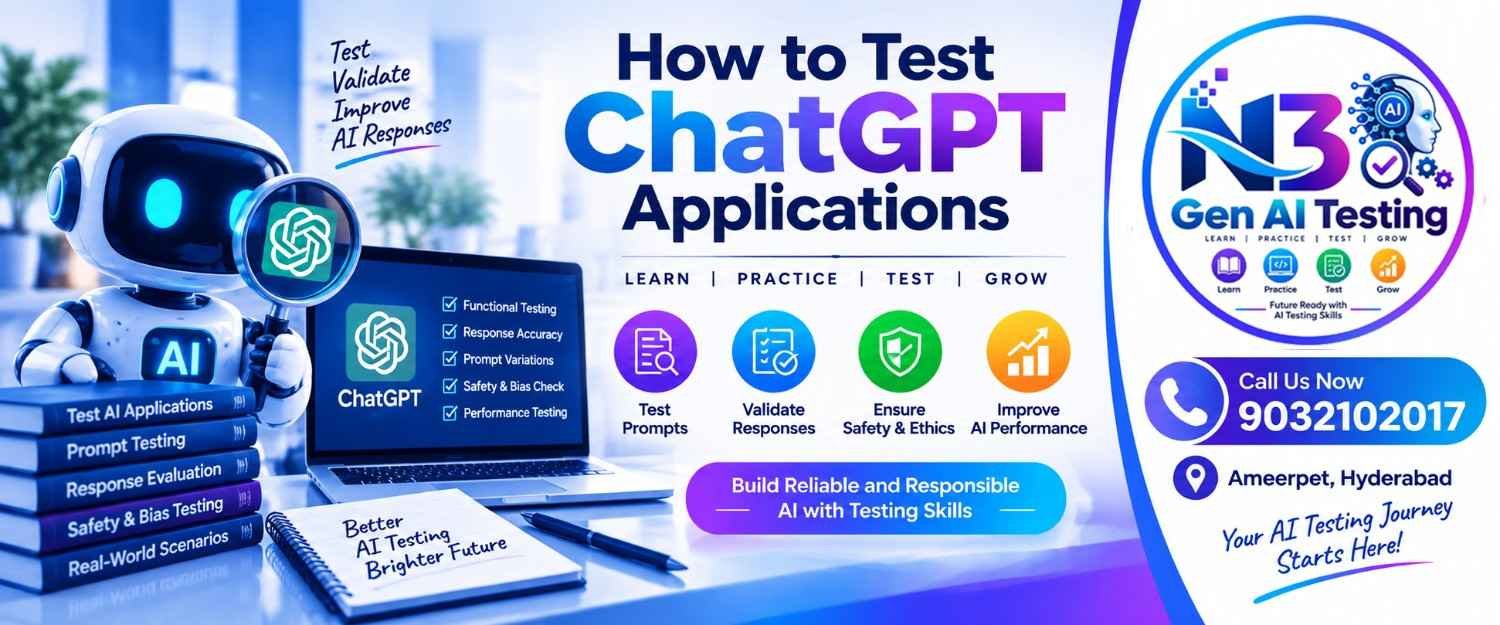
Test ChatGPT Applications: Introduction to ChatGPT Testing
Developers have put an increasing number of ChatGPT applications into practical use, supporting users across a wide range of scenarios including customer service, content generation, information retrieval, virtual assistants, and enterprise business automation. However, to test ChatGPT applications, QA teams cannot directly apply testing frameworks designed for traditional software—the underlying AI model does not generate fixed content. It changes constantly based on users’ input prompts, the contextual background of the conversation, all accumulated historical chat records, the specific underlying model adopted, and the model’s configuration settings, bringing far more variables than traditional software. Therefore, to build a reliable testing strategy, teams must monitor two core components simultaneously: first, whether the core functions of the application itself operate normally; second, whether all responses generated by the AI meet quality standards, pass security checks, and are reliable. Testers must fully test both components.
Test ChatGPT Applications: Map Out the Workflow
Before launching any testing work, the quality assurance team must first clarify one key fact: how exactly the ChatGPT application under test receives user requests, processes them, and finally delivers responses to users. A standard application of this type typically integrates the following modules: a user interface for direct user operation, pre-written system prompts for the AI to follow, user-input prompts, the core AI model that powers the entire application, APIs to connect with various services, supporting databases for storing all types of data, integrated external tools that the application calls, and a response processing module that organizes the AI’s content into the final output.
Only by mapping out each of these modules can testers identify which links in the application’s overall workflow may encounter problems. Testing should also start with the most basic checks, first resolving flaws in core basic functions: confirm that regular users can smoothly input prompts, submit their requests, receive responses from the application, and continue the conversation along previously discussed topics. Even if users trigger abnormal operations, the application must handle them properly, without freezing or failing to process requests.
Once basic functions are stable, teams must prioritize the following core testing directions, with none overlooked:
- User input and prompt processing
- AI response generation
- Conversation context
- API integration
- Response accuracy and relevance
- Error handling
- Security and privacy
- Performance and response time
- Session and conversation management
Test ChatGPT Applications: Multi-Scenario Prompts and Conversation Context
Testing various user input prompts is one of the most critical tasks to ensure the quality of ChatGPT applications. Testers must not only test conventional, logically clear user questions under ideal conditions; they need to design a wide range of prompt types to simulate the various situations real users will encounter, to measure the application’s real performance in actual usage scenarios.
Testers must include specific input types: simple daily questions, complex questions requiring multiple layers of reasoning, incomplete half-sentences, vague requests with unclear demands, long inputs with mixed information, content containing erroneous information, and bizarre inputs that completely exceed developers’ expectations. No matter what response the application generates, the team must check it against pre-defined quality standards to pass inspection.
Testers must verify one by one that all responses align with the user’s question, without answering an unrelated query; they must also comply with the core instructions set for the application, with no inappropriate content; they must provide users with genuinely useful information, without empty statements; and they must retain previously discussed content to maintain correct conversation context, without losing track of the discussion mid-conversation.
Beyond conventional positive testing, negative testing of extreme scenarios is equally critical. The testing team must simulate rare but high-risk situations, such as users submitting invalid inputs or uncommon niche inputs, to confirm that the application can properly handle these exceptions, without generating unforeseen content, or even unsafe responses that could pose risks.
Test ChatGPT Applications: Test Conversation Context and Memory
The vast majority of ChatGPT applications support multi-turn continuous conversations, meaning users do not need to repeat the context of a discussion every time, and can continue the chat from previous exchanges. Therefore, testers must specifically confirm that the application can correctly interpret all previous messages sent by the user, and maintain correct conversation context across consecutive interactions without confusion.
For a practical example: if a user first asks about the basic information of a specific product, and follows up two turns later with the question “What are its advantages?”, the application must correctly identify from the chat history that “it” refers to the product discussed earlier, without responding with information about another item, or even stating that it cannot identify what the user is asking about.
Testers can design their own multi-step continuous conversations, run through the entire sequence to confirm that the conversation context never encounters errors throughout the chat. In addition, testers must evaluate several special complex scenarios: for example, when the chat content accumulates to an extremely long length with a large volume of information across multiple turns; when the user suddenly switches to an entirely unrelated new topic mid-conversation; or when the user’s successive messages contain conflicting information.The team must observe how the application handles these situations, and whether it develops any issues.
Specialized testing of conversation context can proactively identify two critical flaws that heavily impact user experience: one is that the application gradually forgets previously discussed information, forcing users to repeat themselves; the other, more problematic flaw, is that it incorrectly mixes details from different parts of the conversation, misattributing information and generating common-sense errors.
Test ChatGPT Applications: Response Quality, Security and Performance
Evaluating Response Quality and Hallucinations
The testing logic for traditional software is simple: it generally relies on pre-defined expected outputs, and passes if the program’s actual running results match the expectations, and fails if they do not. However, ChatGPT applications are far more difficult to test: the same input prompt may have multiple compliant, usable responses, so it is impossible to judge correctness against a fixed answer.
Therefore, testers must develop a unified, generalizable set of standards to evaluate all outputs generated by the AI. This set of standards includes the following items:
-
Accuracy
-
Relevance
-
Completeness
-
Clarity
-
Consistency
-
Context awareness
-
Appropriate tone
In addition to scoring against these standards, teams must specifically check for “hallucination” issues—meaning the application generates content that sounds logically coherent and plausible, but actually fabricates facts, provides incorrect information, and lacks any supporting evidence. For enterprise-oriented ChatGPT applications, errors in AI-generated content will not only erode user trust in the application, but also disrupt major decision-making within the enterprise, causing tangible losses.
Mitigating Security Risks and Prompt Injection
Security testing is now an indispensable core link in testing ChatGPT applications, and development teams must never omit it. Testers must specifically verify one key risk: whether any actor can manipulate their input prompts to force the application to ignore its originally set core instructions, comply with unauthorized commands, or even disclose confidential internal information.
Specialized testing for prompt injection can proactively identify unpatched security vulnerabilities. If malicious actors input harmful prompts, or even if users accidentally input unexpected prompts that disrupt the application’s original operating logic, these actions put both the platform and the users at risk, potentially causing catastrophic consequences.
In addition to preventing prompt injection, teams must confirm the application does not leak sensitive data, including internal system prompts given to the AI, account credentials for logging into various services, users’ personal private information, and enterprises’ commercial secrets. The system must never disclose any of this content to a third party through public AI-generated responses.
Validating API Integrations and Performance
The vast majority of ChatGPT applications do not operate in isolation; they rely on external APIs and third-party services to function properly, and users cannot operate them without this external support. Therefore, testers must specifically confirm that the application successfully sends user requests to the underlying AI model, correctly receives the AI-generated responses, and smoothly displays them to end-users, maintaining an unbroken connection throughout the entire process.
Performance testing must cover a full range of content, including how long users wait to receive a response after submitting a request, whether the application can support a large number of concurrent users, whether the application can properly handle failures of the API itself, whether it can cope with timeout scenarios where a request receives no response for an extended period, and whether the overall application maintains sufficient stability under various stress conditions.
Establishing a Comprehensive Testing Strategy
A truly reliable ChatGPT application testing plan must integrate all of these testing types to form a coherent workflow, with no missing items: including basic functional testing, prompt testing for various inputs, context testing for chat memory, response quality assessment for output evaluation, security testing to prevent leaks, API testing for external connections, performance testing for stability, and regression testing that runs after every update.
By mastering the practical skills in these fields, testers can better identify the unique issues that only arise in AI applications, help build reliable, secure, and easy-to-use ChatGPT applications, and deliver qualified products for both general and enterprise users. These professional capabilities will also become increasingly valuable for anyone looking to pursue careers such as Generative AI testing specialists or AI quality engineers, as the tech industry urgently needs these core skills.
Looking for the test ChatGPT applications training in Hyderabad? Get in touch with us to learn more about the course.
N3 AI Testing Course
Flat 507, 5th Floor, Annapurna
Block, ADITYA ENCLAVE, Kumar
Basti, Ameerpet, Hyderabad,
Telangana 500038
 Call / WhatsApp: 9032102017
 Website: https://n3genaitestingcourse.in