Gen AI Testing Projects: Introduction and Practical Importance
Nowadays, an increasing number of commonly used software have embedded Generative AI, including chatbots, AI assistants, content generation tools, customer service systems, RAG applications, and AI agents. As more and more people use this type of software, software testers must develop solid, practical capabilities—they need to be able to verify everything from small issues like whether AI-generated responses are reliable and whether input prompts are complete, to large-scale concerns such as the security, accuracy, and operating status of the entire system. Completing several Gen AI Testing Projects by yourself can not only help you master usable skills, but also let you figure out exactly what the differences are between testing Generative AI systems and testing traditional software.
The significance of working on these projects goes far beyond simply checking whether the software can run normally. When facing these AI-integrated tools, testers must evaluate every single generated response to see if it meets a complete set of layered requirements: it must be accurate, relevant to the question, complete, internally consistent, safe, and fully compliant with the user instructions that triggered the response.
Working on these projects allows testers to practice a wide variety of test scenarios by following the usage processes of real software, and also exposes them to specialized testing fields: Prompt Testing Project, LLM testing, hallucination testing, RAG testing, security testing, and automated evaluation.
If you want to accumulate solid, practical experience, there is a set of targeted Gen AI Testing Projects that can cover all core capabilities. You can start testing from the most common application scenarios, gradually move toward more segmented and professional testing directions, and fully develop all relevant related skills step by step.
Gen AI Testing Projects: AI Chatbot and Prompt Testing
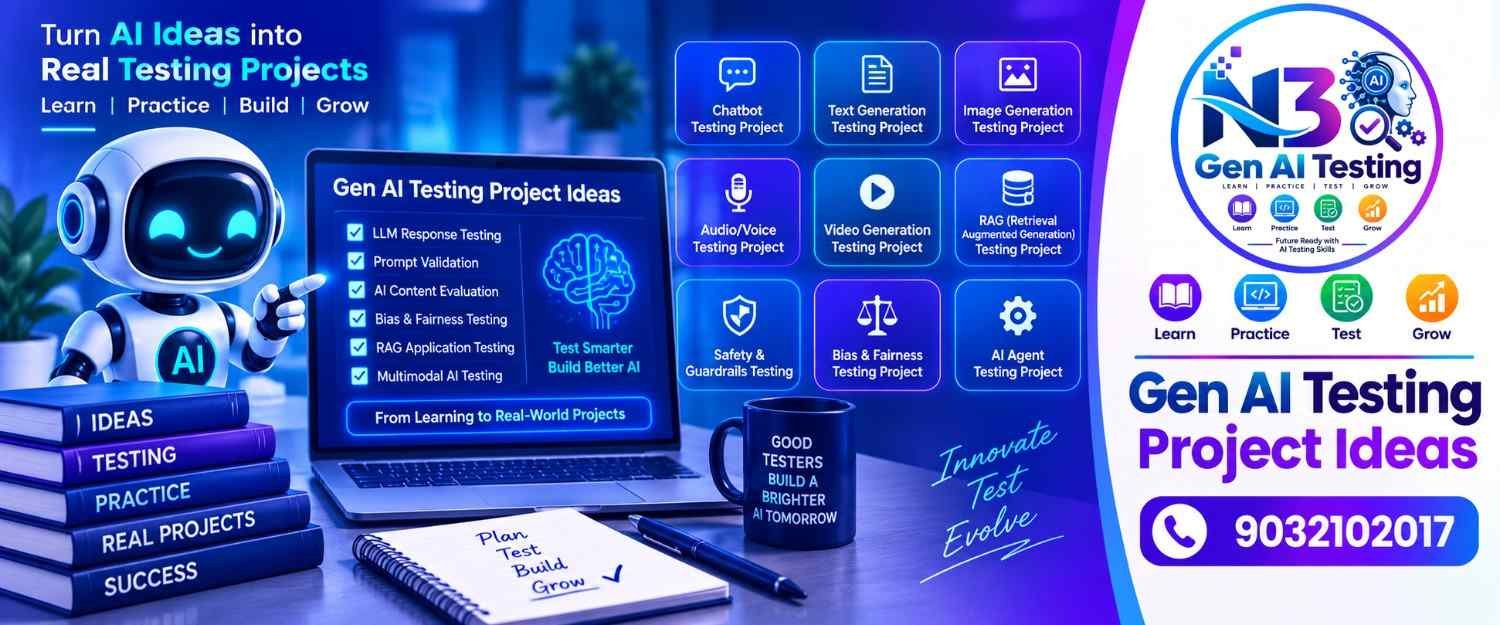
Start with an AI Chatbot Testing Project: build one yourself, or test an existing customer service chatbot similar to ChatGPT directly. The test cases you design must cover various situations: normal questions, incomplete prompt information, ambiguous questions, overly long prompts, conflicting requirements, and completely unexpected inputs.
During testing, you must evaluate responses from several dimensions: whether they are accurate, relevant to the question, clear, internally consistent, and able to generate content in accordance with the given instructions.
This is the most accessible first stop for testers to get in touch with Generative AI testing. After all, everyone uses chatbots in daily life, so they can immediately have an intuitive sense of what makes this type of scenario good or bad, and can quickly get familiar with the basic evaluation logic of Generative AI testing.
Next, you can work on a Prompt Testing Project: sort out a large number of diverse prompts, and test the AI’s response to each one. These prompts must include positive, negative, complex, ambiguous, and malicious prompts.
The core of this project is to identify situations where making only a tiny change to a prompt causes the AI to give an unexpected or inappropriate response. What seems like just fine-tuning a few words in the input can actually test the AI’s boundary of understanding instructions—a unique testing challenge that only arises with Generative AI and rarely appears in traditional software testing efforts.
Gen AI Testing Projects: RAG Application and LLM Evaluation
RAG Application Testing
After completing this, move on to a RAG Application Testing Project: find a Retrieval-Augmented Generation application that retrieves information from a knowledge base before generating responses to test.
The test scenarios you design must include questions related to the knowledge base, completely unrelated questions, information that does not exist in the knowledge base at all, and conflicting information, to confirm whether the application can retrieve appropriate data and generate reliable, trustworthy responses.
This type of application that needs to look up materials before generating responses is one of the mainstream forms of Generative AI implementation today. Testing it requires not only evaluating the generated responses, but also first verifying that it has found the correct reference materials, adding an extra layer of inspection compared to simply testing a chatbot.
LLM Response Evaluation
Then work on an LLM Response Evaluation Project, which can fill in another core capability: create a test dataset that includes both the input prompts and the pre-defined quality requirements that responses must meet, then score the AI’s responses from the dimensions of accuracy, relevance, completeness, clarity, consistency, and context comprehension ability.
After completing this project, testers can fully understand the exact differences between LLM evaluation and the pass-or-fail judgment in traditional software testing. Traditional software testing only produces two results: qualified or unqualified. But the responses generated by large language models rarely fall into a clear black-or-white category; most meet some requirements while having other shortcomings.
This flexible evaluation logic is a transition that every Generative AI tester must adapt to.
Generative AI Security Testing
Next is a Generative AI Security Testing Project, which can help you develop risk prevention and control capabilities: design dedicated security test cases for risks such as prompt injection, instruction manipulation, sensitive information leakage, and generation of unsafe content.
The core goal is to verify whether any user can manipulate the AI, bypass pre-set rules, or leak protected information. This core testing link directly relates to whether teams can safely launch Generative AI.
Gen AI Testing Projects: Automation, Regression and Portfolio
Streamlining QA with Test Automation
Finally, you can also try an automation and regression testing project: automation is a fast-developing, important direction in current Generative AI testing. Testers can build a set of automatically operating processes that input multiple prompts at once, then evaluate all responses according to pre-set standards, eliminating the need to manually input tests one by one.
This can greatly improve testing efficiency to meet the growing demand for Gen AI Testing Projects.
Managing Continuous Updates with Regression Testing
For regression testing, you can store all test prompts in a unified dataset. Whenever developers update the model, prompts, application logic, or supporting data, you can retest with the same batch of prompts to promptly discover whether the AI’s behavior has undergone any unexpected changes.
After all, developers frequently update the Generative AI model and its supporting knowledge base, and each update may introduce problems that never occurred before. Repeatedly testing with the same fixed set of test cases allows you to identify these sudden problems in a timely manner.
Building a Comprehensive Gen AI Testing Portfolio
By working on several different projects, testers can comprehensively and thoroughly understand the quality assurance work of Generative AI. Organizing these results into a Practical Gen AI Testing Portfolio can also showcase your professional capabilities to relevant stakeholders.
A solid portfolio can include content related to chatbot testing, prompt testing, LLM evaluation, RAG testing, hallucination testing, security testing, automation testing, and regression testing.
When selecting Gen AI Testing Project Ideas to work on, it is best to choose projects that cover different testing challenges, and do not keep repeating the same type of application. After all, the more scenarios you practice, the more comprehensive the actual problems you can handle, so you will not be at a loss when encountering an unforeseen testing requirement.
Documenting Results to Showcase Practical Experience
Record every project’s test scenarios, test cases, evaluation standards, detected problems, and final test results, and you will have a solid, practical proof of your hands-on experience. Whether you are looking for a job or managers are assessing your abilities, this record is far more useful than vague theoretical descriptions.
By completing these practical Gen AI Testing Projects by yourself, software testers can build a solid foundation of AI testing knowledge, overcome various testing challenges encountered in reality, and develop the skills urgently needed in this rapidly developing field of Generative AI quality assurance.
Want to learn more about Gen AI Testing Projects in Hyderabad? Contact:
N3 AI Testing Course
Flat 507, 5th Floor, Annapurna
Block, ADITYA ENCLAVE, Kumar
Basti, Ameerpet, Hyderabad,
Telangana 500038
 Call / WhatsApp: 9032102017
 Website: https://n3genaitestingcourse.in