What Are Gen AI Test Cases?
Testing generative AI isn’t like testing regular software. With traditional software, the same input always gives you the same output. Generative AI doesn’t work that way — ask it the same question twice, and you might get two different answers. Gen AI test cases exist to handle that unpredictability.
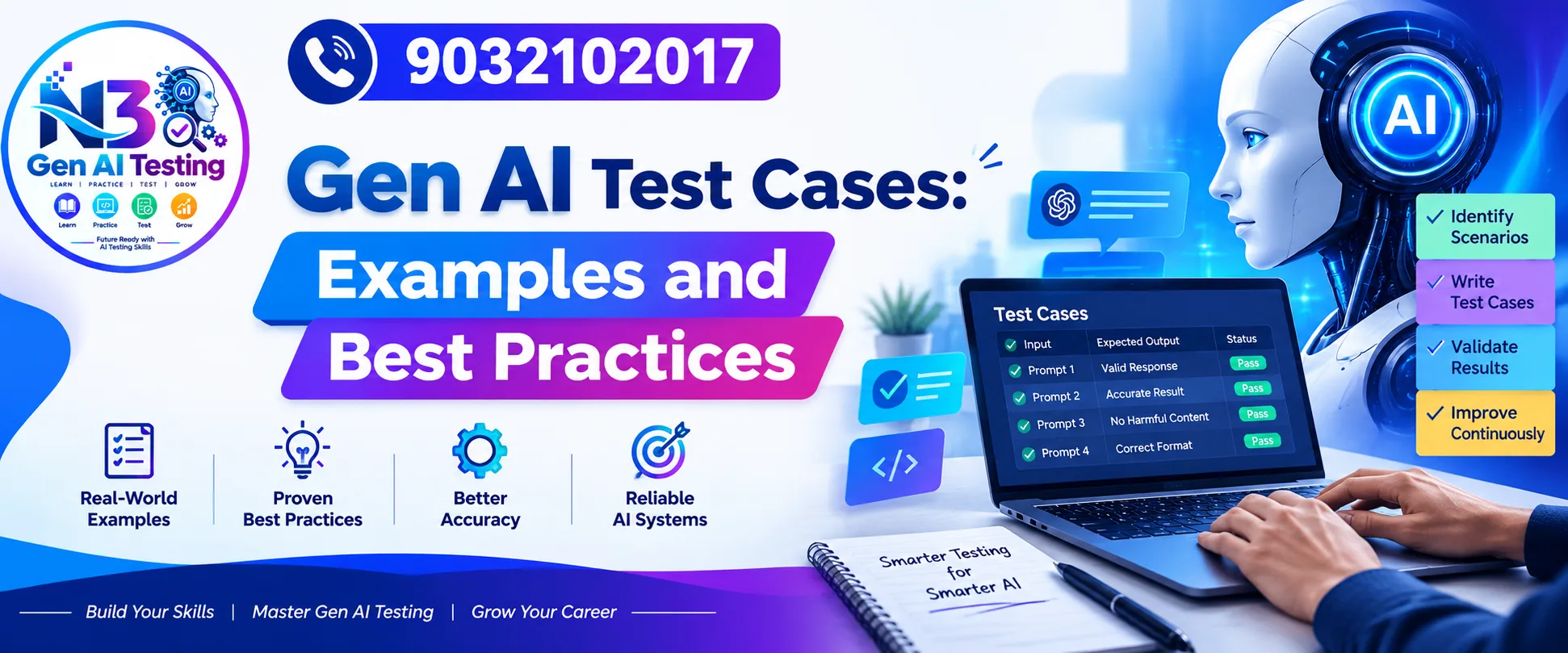
A good test case usually includes: the prompt you gave the AI, what you expected back, clear pass/fail criteria, what the AI actually said, and the final result. This structure helps QA teams catch the things that tend to go wrong with AI — wrong answers, made-up information, biased responses, security holes, and other risky behavior.
A quick example: Say you’re testing a customer service chatbot before launch. You could pose as a customer and ask about the return policy, then check whether the bot’s answer actually matches company policy. If it doesn’t, you’ve just caught a bug that could have led to real complaints.
The 7 Main Types of Gen AI Testing
Every AI system is different, so your tests should match what the system is actually used for. Here are the seven categories most teams rely on:
Accuracy Testing Ask questions with clear, verifiable answers, then check the AI’s response against a trustworthy source. Simple, but essential.
Prompt Testing Throw everything at it — clear questions, vague ones, incomplete ones, convoluted ones. This shows you how the system handles the messiness of real users.
Hallucination Testing Check whether the AI is making things up. This one matters most in high-stakes fields like finance, healthcare, or business, where a confident-sounding wrong answer can do real damage.
Consistency Testing Send the AI nearly the same question multiple times. Tone can vary — casual one time, formal the next, that’s fine. But facts shouldn’t. If it says the return window is 7 days in one answer and 15 days in another, that’s a real problem.
Security Testing Try to break it. Prompt injection, attempts to leak sensitive data, ways to get around platform rules — if there’s a loophole, someone will eventually find it, so you want to find it first.
Bias Testing Run inputs that reflect different backgrounds and situations, and check whether the AI treats everyone fairly. This protects users and protects you from discrimination complaints.
Performance Testing Can the system handle real traffic? Test response times and stability under load — what happens with 100 users? 1,000? You don’t want to find out during a traffic spike.
Best Practices for Building Test Cases
Start with clear objectives. Decide up front what you’re actually testing — accuracy, relevance, security, consistency, speed, overall experience — instead of testing everything a little and nothing well. Write it down so the team stays aligned.
Use a wide range of prompts. Simple test questions won’t cut it. Mix in complex, ambiguous, negative, and extreme prompts so you’re actually simulating how real users behave.
Build criteria that fit the scenario. A flat pass/fail doesn’t capture how AI actually performs. Score responses across several dimensions — accuracy, relevance, completeness, tone, security — instead of forcing everything into a binary.
Don’t skip the edge cases. Incomplete questions, typos, contradictory instructions, overly long prompts — these show up constantly in the real world. Test for them before launch, not after.
Make hallucination testing non-negotiable. Check high-risk outputs against solid, verified sources every time. This is one of the most common ways AI systems fail, and one of the most costly to get wrong.
Automate what repeats. Manually re-running the same tests wastes time. Automation lets you test at scale and catch regressions quickly after updates — freeing your team to focus on the judgment calls that actually need a human.
Why It’s Worth the Effort
Solid, ongoing testing catches problems before your users do — which means fewer legal headaches, less reputational damage, and less scrambling to fix things after they’ve already gone wrong. It also frees your team from repetitive manual work, so the people with real expertise can spend their time on the harder calls: judgment, risk analysis, and the kind of quality checks that automation can’t replace.
Get the fundamentals right — accuracy, prompt handling, hallucinations, security, bias, consistency, and real-world performance — and you end up with an AI product people can actually trust.
 Visit Our Training Center
Flat 507, 5th Floor, Annapurna Block, ADITYA ENCLAVE, Kumar Basti, Ameerpet, Hyderabad, Telangana 500038.
 Call Us
+91 90321 02017