LLM Evaluation: Introduction to Traditional and AI Testing
Today, developers increasingly apply Large Language Models (LLMs) across various industries, integrating them into chatbots, virtual assistants, content generation tools, software development workflows, customer service systems, and general enterprise software. Testing these systems requires completely different methods than traditional software testing — even when a user inputs the exact same content, the model may still generate entirely different responses. By understanding the differences between LLM evaluation and traditional testing, testers can determine how to conduct quality checks for ordinary software and identify the specialized evaluation methods AI-integrated applications require.
LLM Evaluation: What Is Traditional Software Testing?
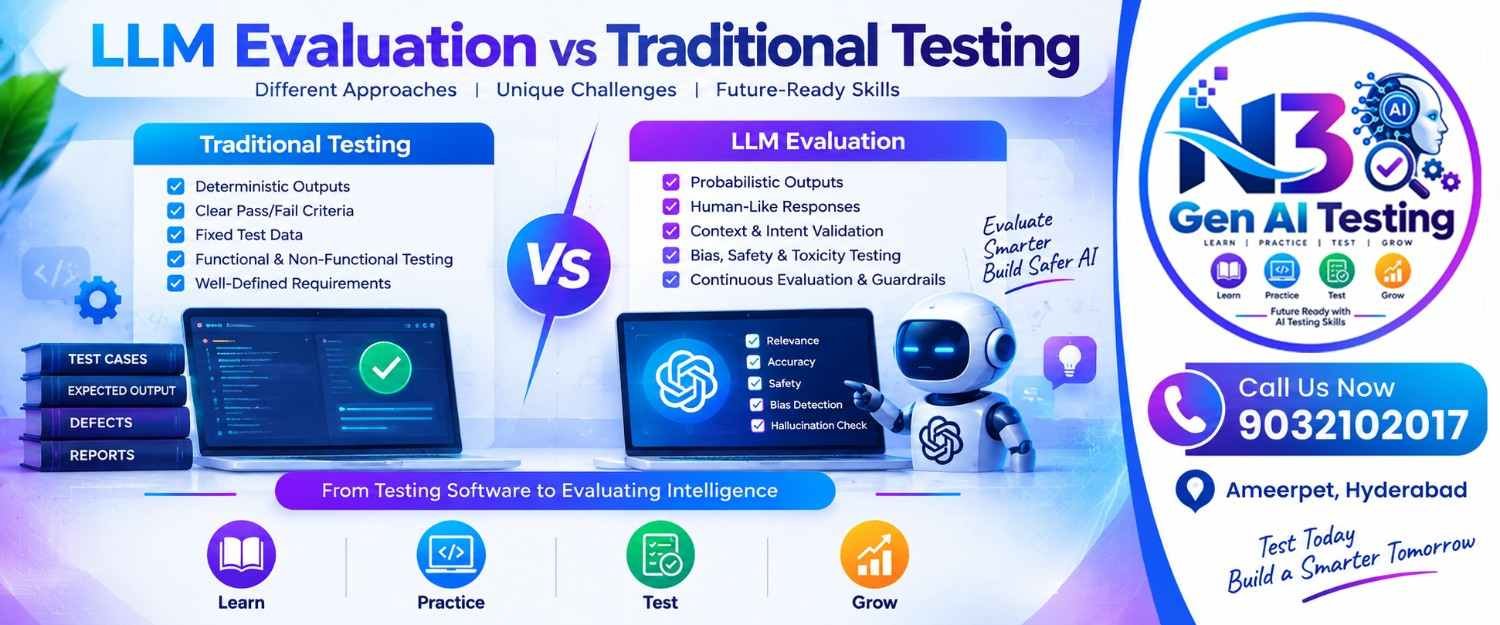
The core of traditional software testing is to confirm that an application operates in line with all pre-specified requirements. Testers usually write test cases first. Each case clearly specifies the designated input content, the specific output the system should produce, and the conditions that determine a pass or fail, fixing all standards in advance.
For example, if a login application requires users to input a valid username and password to gain access, testers can input the correct account credentials to personally verify that the user can log into the system smoothly, with no freezes or permission errors throughout the process. Testers clearly define this Expected Result from the start, making pass or fail judgments a simple matter of cross-checking against pre-set standards.
Common Traditional Testing methods include:
- Functional Testing
- Regression Testing
- Integration Testing
- API Testing
- Performance Testing
- Security Testing
- User Interface Testing
These testing methods function stably only when an application exhibits predictable performance and testers can clearly define its expected output in advance. If a team cannot fix a software’s output ahead of time, applying these mature, established methods becomes difficult.
LLM Evaluation: Understanding Expected Results and Performance
The core of LLM Evaluation is to measure the quality and performance of applications integrated with Large Language Models. Unlike traditional testing, testers do not only focus on whether the system outputs the precise pre-defined result; instead, they evaluate whether the generated response meets a specific set of quality standards.
For example, a customer service chatbot may repeatedly receive the exact same question, and produce responses with slightly different phrasing each time: one time it says “Let me look into your issue for you”, and the next it says “Please wait, I will verify the relevant information for you immediately”. The wording differs, but the core attitude and intended action are consistent. As long as every response remains correct, relevant, complete, and useful, teams fully accept all these differing outputs. Testers will not mark the test as failed simply because the model changed its phrasing.
For this reason, LLM Evaluation examines a series of factors completely different from those of traditional testing, including:
- Accuracy
- Relevance
- Completeness
- Clarity
- Consistency
- Context awareness
- Ability to follow instructions
- Security
LLM Evaluation: Core Differences in Expected Results
One of the most notable gaps between the two types of testing is that their methods of defining Expected Results are completely different: one requires a fixed, unique answer, while the other allows flexible outputs that meet standards.
In traditional testing, the expected output is almost always precise, with no room for extra words or incorrect numbers. For example, a calculation tool must return the correct numerical result every time a user inputs the same content; entering 1 plus 1 can only output 2, with no other possible outcomes, otherwise testers consider it a failure.
Applications that use Large Language Models are completely different: the same question may have dozens of reasonable response methods. The wording of responses can vary widely, as long as the core meaning conveyed is completely accurate and can help users solve their problems. There is no strict standard that enforces word-for-word consistency to find faults.
It is precisely because of this flexibility that testers of large language models usually rely on a set of structured evaluation criteria to make judgments, rather than fixating on a single fixed expected response. They only confirm whether the generated output meets all required conditions, instead of comparing the output line-by-line and word-by-word against a pre-written template, saving a great deal of unnecessary effort nitpicking over details.
LLM Evaluation: Accuracy, Hallucination, Automation and Security
Nearly all traditional applications, given the same input and consistent operating conditions, output predictable, consistent results; the application produces the same result even if a user enters the input ten thousand times. The performance of Large Language Model applications is far more flexible: even if the input remains completely unchanged, the model might generate a different response, and developers cannot predict in advance exactly which phrasing it will use.
This means that testers must run the same prompt many times repeatedly, running it ten or dozens of times, then check that every generated output maintains a quality level above the pre-defined acceptable threshold, with no sudden emergence of unqualified responses.
This repeated testing method can help you identify inconsistent performance, unexpected nonsensical or harmful responses, and also detect various performance changes triggered by modifications to prompts, underlying models, an application’s core logic, or supporting datasets, to block risks brought by changes in advance.
LLM Evaluation: Accuracy and Hallucination Testing
Most traditional software testing only needs to confirm that the application operates normally according to pre-set hard-coded logic; as long as the code written by programmers is correct, the software will not make fundamental errors. LLM Evaluation adds a layer of critical requirements: it must also confirm that all information generated by the model is factually accurate, with no random fabrication.
A Large Language Model may generate a response that sounds fluent and persuasive but contains incorrect or unsubstantiated information, presenting non-existent events and wrong parameters as if they were real. The industry widely refers to this common flaw as hallucination.
Testers can design targeted, specific test scenarios to flag these hallucinations one by one, and also confirm that the application can either output consistent and reliable information, or truthfully state that it lacks sufficient information to answer a question, instead of forcing a fabricated answer to deceive users.
Automating the Evaluation Process
Testers commonly use automation as a standard tool in traditional testing because test scripts can almost always automatically compare and verify the expected outputs. A program can cross-check the system’s output against the standard answer and produce a result in seconds, without requiring manual testing for each case.
Teams can also fully automate testing for Large Language Models, but evaluating the responses they generate requires more complex and refined methods, and engineers cannot rely on simple string comparison to make judgments.Automated large language model testing systems can judge the quality of responses based on pre-set quality standards, standardized evaluation datasets, formal scoring methods, or other specialized evaluation technologies, using a set of quantitative rules to replace initial manual screening.
The Ongoing Need for Human Review
If a response involves subjective judgment factors, such as overall practicality, clarity of tone, alignment with brand tone, or contextual relevance, these soft standards that are difficult to enforce with rigid rules mean that human evaluation remains an extremely valuable part of large language model testing, and machines cannot fully replace human judgment.
Only by combining automated LLM Evaluation with targeted manual reviews can the most comprehensive and reliable test coverage be provided for applications built on Large Language Models, with no link that may develop problems overlooked.
Mitigating Security and RAG Vulnerabilities
Both traditional applications and applications integrated with Large Language Models require solid security testing to prevent risks such as malicious intrusions and information leaks. However, AI systems bring a whole new set of risk scenarios that testers must additionally address—all of which are new problems developers never encounter in traditional software.
Teams may need to evaluate various new types of risks, including prompt injection, instruction manipulation, accidental leakage of sensitive information, and the generation of unsafe or harmful content, to block AI-specific security vulnerabilities one by one.
If an application uses Retrieval-Augmented Generation, or RAG technology — that is, a large language model application that can retrieve information from a dedicated knowledge base to generate responses — testers must also evaluate whether the system can stably retrieve appropriate source information, and whether the generated response is truly and accurately based on these correct sources, without deviating from the content of the knowledge base to fabricate content independently.
LLM Evaluation: Choosing the Right Testing Strategy
A comparison between LLM Evaluation and Traditional Testing reveals that in modern software development, both methods are indispensable, and neither can replace the other. These testing methods function stably only when an application exhibits predictable performance and testers can clearly define its expected output in advance. If a team cannot fix a software’s output ahead of time, applying these mature, established methods becomes difficult.
LLM Evaluation, meanwhile, adds a critical new dimension of evaluation, specifically used to inspect AI-generated responses and the performance of underlying models, filling in the AI-specific links that traditional testing cannot cover.
A comprehensive and reliable testing strategy must combine standard traditional software testing with specialized inspection items for large language models: prompt testing, response quality evaluation, hallucination detection, AI-specific security testing, RAG verification, and regression evaluation tailored for large language models, to cover all testing links comprehensively.
As more and more enterprises adopt Generative AI applications in their business operations, only testers who master both traditional software testing methods and modern LLM Evaluation capabilities can possess the practical skills to thrive in the current AI testing environment, and help build more reliable, secure, and trustworthy AI-integrated applications.
Want to learn more about the LLM Evaluation in Hyderabad? Contact:
N3 AI Testing Course
Flat 507, 5th Floor, Annapurna
Block, ADITYA ENCLAVE, Kumar
Basti, Ameerpet, Hyderabad,
Telangana 500038
 Call / WhatsApp: 9032102017
 Website: https://n3genaitestingcourse.in
Pingback: Gen AI Testing Projects: Practical Project Ideas for AI Testers