Complete Guide for AI Testing in Hyderabad
Generative AI is reshaping every aspect of software development, customer service, automation, content creation, and enterprise operations at an extraordinary pace. From AI tools that automatically write marketing copy for businesses to customer service robots that handle user inquiries instead of human agents, it compresses work that once took humans hours or days to complete into just a few minutes or even seconds, while remaining flexible to adjust to evolving business needs. Today, AI chatbots, virtual assistants, Large Language Models (LLMs), various AI-powered applications, and intelligent automation tools have become deeply integrated into every part of enterprises’ daily workflows—from administrative teams using AI to automatically compile meeting minutes, to production departments using AI to optimize supply chain scheduling.
These tools are no longer niche experimental gadgets; they are essential configurations that genuinely boost enterprise efficiency. As more and more businesses integrate these tools into their operations, testing Generative AI applications has become a critical step before launch. This process ensures the accuracy, reliability, security, performance, and user satisfaction of every deployment.
It is unacceptable to wait until the tool is rolled out to employees or customers only to discover that it provides incorrect information, omits key details, or even leaks confidential internal data. To take a simple example: a traditional enterprise attendance software passes testing as long as it can correctly log clock-ins, calculate salaries, and export reports.
But for an AI chatbot used by customer service teams, merely being able to “generate text” is far from sufficient. It cannot misstate refund policies to customers, deliver inappropriate responses during user complaints, or arbitrarily disclose other users’ private information. These are requirements unique to AI applications that demand additional verification.
What Is Gen AI Testing?
Gen AI Testing is a standardized process for evaluating applications powered by Generative AI models, designed to confirm that their output is reliable, accurate, secure, and aligned with requirements to meet the needs of predefined use cases. But a Generative AI application may produce completely different responses even when receiving nearly identical instructions. The wording differs, but the core information is correct. This fundamental difference requires QA engineers to adopt additional specialized testing strategies to fully evaluate the performance of AI systems.
Test for Hallucinations
Hallucination testing must be a core component of any comprehensive Generative AI Testing strategy to mitigate this high-risk issue. Testers can build dedicated scenarios to intentionally induce the model to output non-existent or uncertain information. Hallucination testing is especially critical for core business AI applications that impact customer experience or support high-stakes internal decision-making. Incorrect information generated by AI can cause long-term damage to a company’s reputation and revenue.Generative AI Testing Best Practices
Perform Security Testing
For example, can a regular employee prompt the AI to disclose the company’s core financial data through carefully crafted questions? Security checks must be integrated from the initial requirements phase, through every step of development, testing, and launch. Identifying and resolving issues early is far more reliable than patching vulnerabilities just before launch.
Test Consistency and Reliability
Generative AI may produce slightly different responses to similar prompts, and small natural fluctuations are normal and acceptable. But all output must fall within predefined acceptable quality standards, and core information must never be incorrect. You cannot spend half the testing period without a unified standard for what constitutes a qualified response. The wording can vary to sound natural, but the underlying factual details must be accurate in every response. If it says refunds take 3 days one time and 7 days the next, that is an unacceptable error. This makes consistency testing a core, ongoing component of all Gen AI Testing Best Practices.
Use Regression Testing
A small change that fixes an issue in one test scenario may accidentally break functionality in a completely unrelated scenario. For example, if you revise the AI’s logic for handling refund inquiries to make its responses more accurate, you might inadvertently break its ability to handle exchange inquiries. This type of unforeseen cross-scenario impact is common in AI application iterations. Regression testing identifies these unintended flaws before they affect users. Enterprises must compile a library of high-priority core test cases, and run all cases every time the AI application receives a major update, to confirm that previously functional features remain working after the update. Automated regression testing is especially useful for frequently updated AI applications whose core or supporting systems are often modified. It eliminates the need to manually rerun hundreds or thousands of test cases every time, saving significant time and effort.
Test Edge Cases
If the model has never encountered a similar situation during training, it is prone to errors when it does arise. Testers must proactively anticipate situations that rarely occur in real use but would cause serious harm if unaddressed. You cannot dismiss these scenarios as too uncommon to test—even one occurrence can lead to major problems.
Gen AI Testing Best Practices for QA Practitioners in Hyderabad
The city’s technology industry ecosystem is highly mature, and demand for professional technical talent remains consistently high. As AI adoption among local enterprises continues to accelerate, more and more companies are integrating AI tools into their operations. Ameerpet itself is a well-known education and training hub in Hyderabad, where many local IT practitioners go to upskill. It has mature transportation and supporting facilities, so you do not need to travel far to attend classes.Gen AI Testing Best Practices in Hyderabad
Career Opportunities in Gen AI Testing
AI adoption across all industries is growing rapidly, from the internet to manufacturing, finance to retail. TheseComposite type (hybrid skill set) professionals are in extremely high demand, and many enterprises cannot recruit enough qualified candidates.
In-demand roles that skilled Gen AI testers can fill include: Gen AI Tester, AI Test Engineer, Generative AI QA Engineer, AI QA Analyst, LLM Test Engineer, AI Automation Tester, and Quality Engineer for AI Applications. Salaries for these roles are generally higher than those for traditional software testing positions, and they offer significant future growth potential.
Conclusion
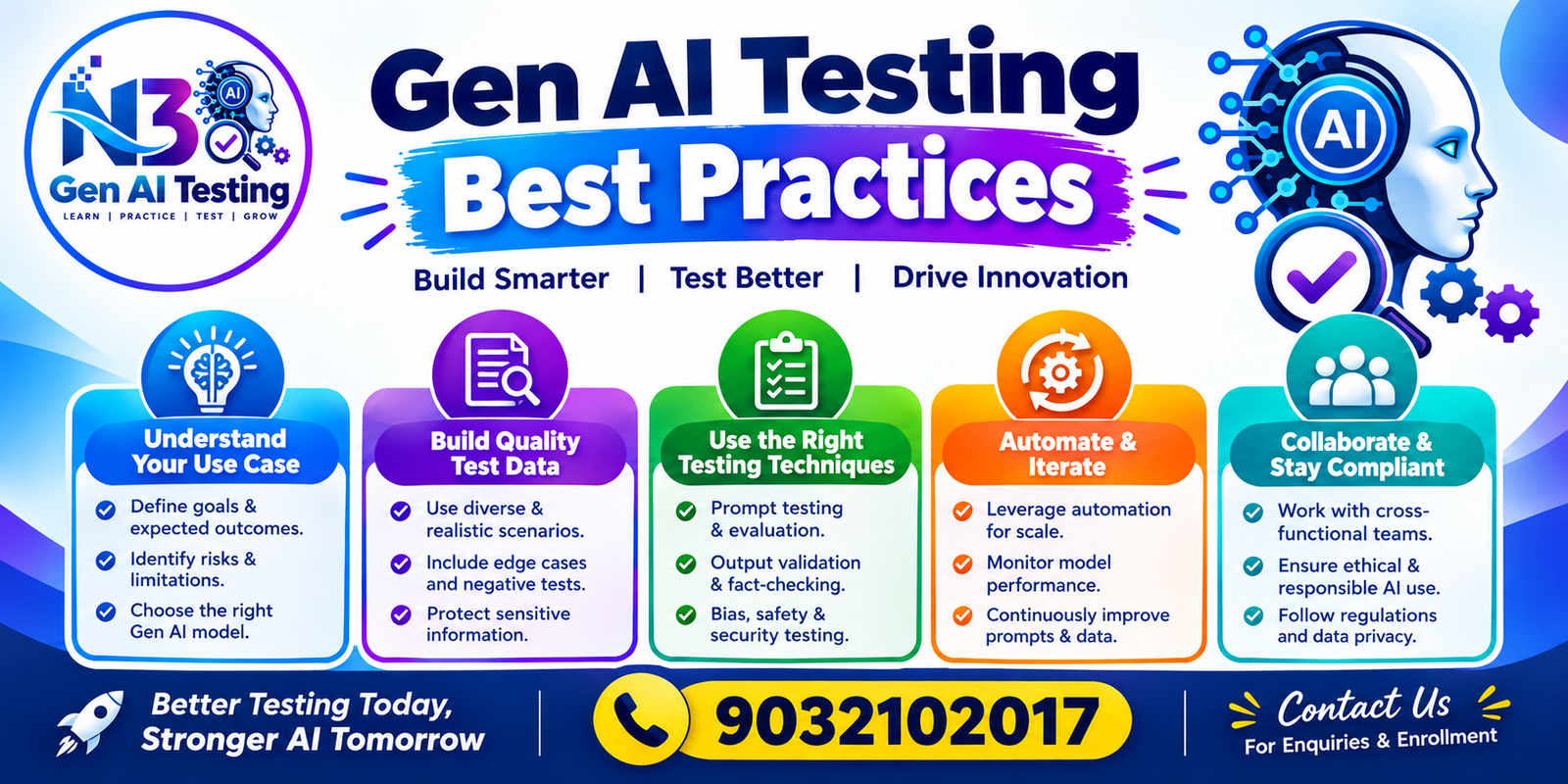
Gen AI Testing Best Practices provide a structured, actionable framework to thoroughly test modern AI-powered applications, eliminating the confusion of not knowing where to start when testing an AI application, and clearly outlining every step of the process.
From defining clear testing objectives and building comprehensive test scenarios, to executing prompt testing, response validation, hallucination testing, security testing, performance testing, regression testing, and ongoing post-launch monitoring, every step of the testing process helps you deliver more reliable, higher-quality AI tools that enterprises feel confident using and users want to adopt.
As Generative AI adoption across industries continues to grow, enterprises urgently need professionals who can effectively evaluate AI applications, and AI testing engineers who understand the field are in high demand everywhere. The talent gap in this sector will continue to widen.