Type “AI testing” into a search bar and you’ll get a dozen different answers, half of which quietly mean something else entirely. That confusion is exactly why AI testing vs Gen AI testing keeps coming up in QA conversations lately — the two terms get used interchangeably, but they’re not the same thing, and mixing them up leads teams to buy the wrong tool or set the wrong expectations.
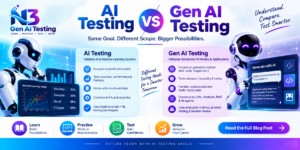
Here’s the short version. AI testing is the broader umbrella — any use of artificial intelligence to support testing work, from smart test prioritization to anomaly detection. Gen AI testing is a specific slice of that umbrella, where generative AI actually creates and adapts the tests themselves, not just analyzes them.
This article untangles the two, walks through how Gen AI testing actually works day to day, and points out where each approach earns its keep.
AI Testing vs Gen AI Testing: The Actual Definitions
Here’s a version worth quoting: AI testing refers to any application of artificial intelligence within the testing process, while Gen AI testing specifically uses generative AI models to create, execute, and maintain tests with minimal manual scripting.
Traditional AI testing tools often do things like flag anomalies, prioritize which tests to run first, or predict where bugs are likely to appear. Useful work, but the tests themselves are usually still written by a human. Gen AI testing goes further. Give it requirements or a user story, and it drafts the test case itself. It can also generate realistic test data and patch a script when the app’s UI shifts underneath it.
Put plainly: AI testing often assists human-written tests. Gen AI testing helps write the tests in the first place.
Why the Difference Between AI Testing and Gen AI Testing Actually Matters
This isn’t just semantics — it changes what you should expect from a tool or a hire.
Release cycles keep shrinking, and teams relying purely on AI-assisted (but human-scripted) testing still hit a ceiling on speed. Gen AI testing removes a chunk of that manual scripting altogether, which is why release cycles shorten noticeably once teams adopt it. Manual effort drops too, freeing testers to focus on strategy instead of typing out the same steps for the twentieth time. Coverage widens because generative models tend to catch edge cases a rushed manual pass misses. And because fewer tests break every sprint, the actual cost of running QA falls. Anyone researching AI software testing options should know which category they’re actually shopping in before comparing tools.
How Gen AI Testing Actually Works
A handful of specific techniques set it apart from plain AI-assisted testing.
AI-generated test cases come straight from feeding the model your requirements or user stories — it drafts scenarios without a human writing each one by hand. Synthetic test data generation produces realistic datasets without pulling real customer information into a test environment. Self-healing test scripts detect UI changes and patch themselves instead of failing outright. Visual and UI testing catches layout shifts a purely functional check would miss. And natural language to test script conversion means a tester describes a scenario in plain English and gets working code in return.
Standard AI testing tools rarely do all five of these together — most focus on one or two, like prioritization or anomaly detection.
Where Each Approach Gets Used
Regression testing benefits heavily from Gen AI testing, since old functionality gets re-verified without rewriting scripts each release. API testing improves when specs convert directly into request-and-response scenarios. Chatbot and LLM output testing is genuinely hard to do manually, which is part of why generative AI quality assurance has become close to standard practice there. Exploratory testing gets a real boost from AI suggesting untested paths. Meanwhile, plain AI testing tools still earn their keep in areas like flaky-test detection and smart test-run prioritization, where you don’t necessarily need generative capability at all.
What You Actually Gain
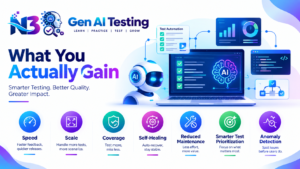
Gen AI testing wins on speed, scale, and coverage, and self-healing scripts cut down on flaky failures clogging up your pipeline. Maintenance overhead drops noticeably too. Broader AI testing tools still add value on their own — smarter prioritization and anomaly detection help even without generative capability, and some teams layer both together rather than picking just one.
Where Both Approaches Still Fall Short
Neither is flawless. Generative models can hallucinate, producing a test case that looks fine but doesn’t actually reflect your app’s real behavior — human review still matters here. Tooling across this whole space is still maturing, so expect some rough edges no matter which category you pick. Data privacy also needs real attention if sensitive information feeds into any AI model, generative or not.
Tools Worth Knowing About
Broadly, you’ll run into AI-augmented test automation platforms, synthetic data generators built for QA, visual testing tools with AI-based comparison, and evaluation frameworks aimed specifically at LLM output. If you’re comparing options and want a deeper breakdown, our AI Testing vs Gen AI Testing training walks through practical selection criteria for both categories.
Getting Started Without Overcomplicating It
Start with a low-risk area like regression testing. Keep a human reviewing AI-generated tests, at least early on. Track real metrics — coverage, flakiness, time spent on maintenance — to see whether the shift is actually paying off. Train your team on prompt writing and on sanity-checking AI output critically. Then expand gradually into API, UI, and eventually LLM-specific testing.
Final Take
AI testing vs Gen AI testing isn’t really a competition — it’s a spectrum. AI testing covers the broader category, and Gen AI testing sits at the more advanced end, where generative models actually build and adapt the tests themselves. Most mature QA teams end up using both, matching the right tool to the right job rather than betting everything on one label.
Want a clearer path through both categories? Explore our Gen AI testing course and see where your team’s QA strategy has the most room to grow.
N3 Gen AI Testing Course
 Phone: 90321 02017