Generative AI Testing Challenges
Generative AI is reshaping the software industry, enabling various applications to generate text, code, images, summaries, recommendations, and a wide range of other content forms. Put simply, the power of AI allows applications to no longer only respond passively to users’ fixed operations, but also proactively produce all kinds of content that people need, which has brought a complete shift to the development direction of the entire software industry.
A growing number of enterprises have recognized the potential of this technology and have begun to launch AI-enabled applications one after another. In turn, the demand for reliable testing of these generative AI applications has become more urgent than ever. It is impossible to carry out subsequent testing work without a clear understanding of the problems to be faced.
What Is Generative AI Testing?
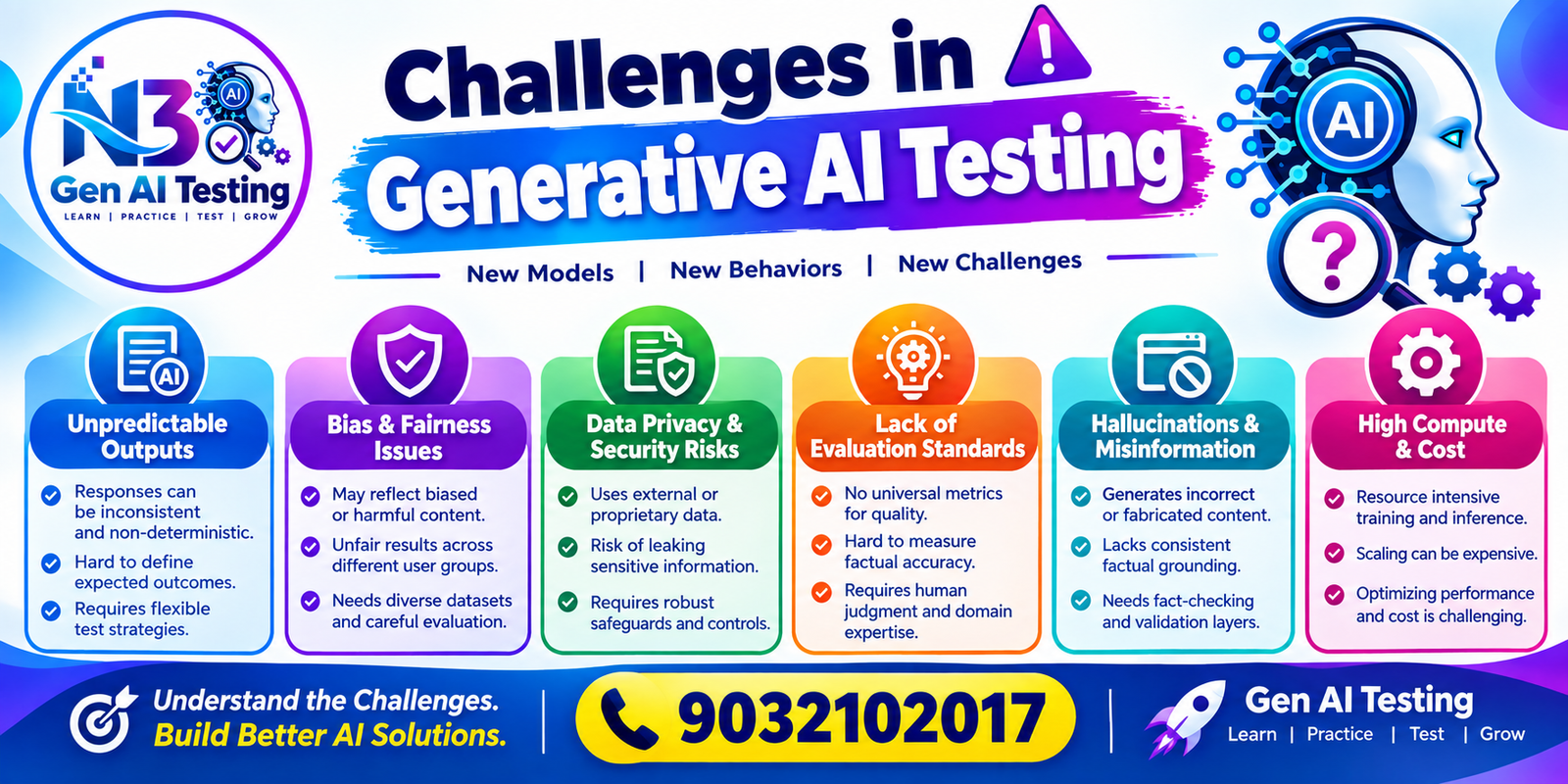
Generative AI Testing refers to conducting a comprehensive evaluation of AI-powered applications, checking their accuracy, reliability, consistency, security, operating performance, and overall quality. It must cover all aspects, from the technical-level operating status to the qualification level of the output content, without missing any link that may malfunction. After all, when testing traditional software, as long as the input is fixed, the output should be the pre-set unique result, and it only needs to be checked against the expected result. But this logic simply does not work for generative AI. The dimensions to be investigated are far more numerous than those of traditional testing. It is not only necessary to ensure the technical stability, but also to verify that the output content is reliable and can truly help users. AI Testing Best Practices
Major Challenges In AI Testing
Non-Deterministic AI Responses
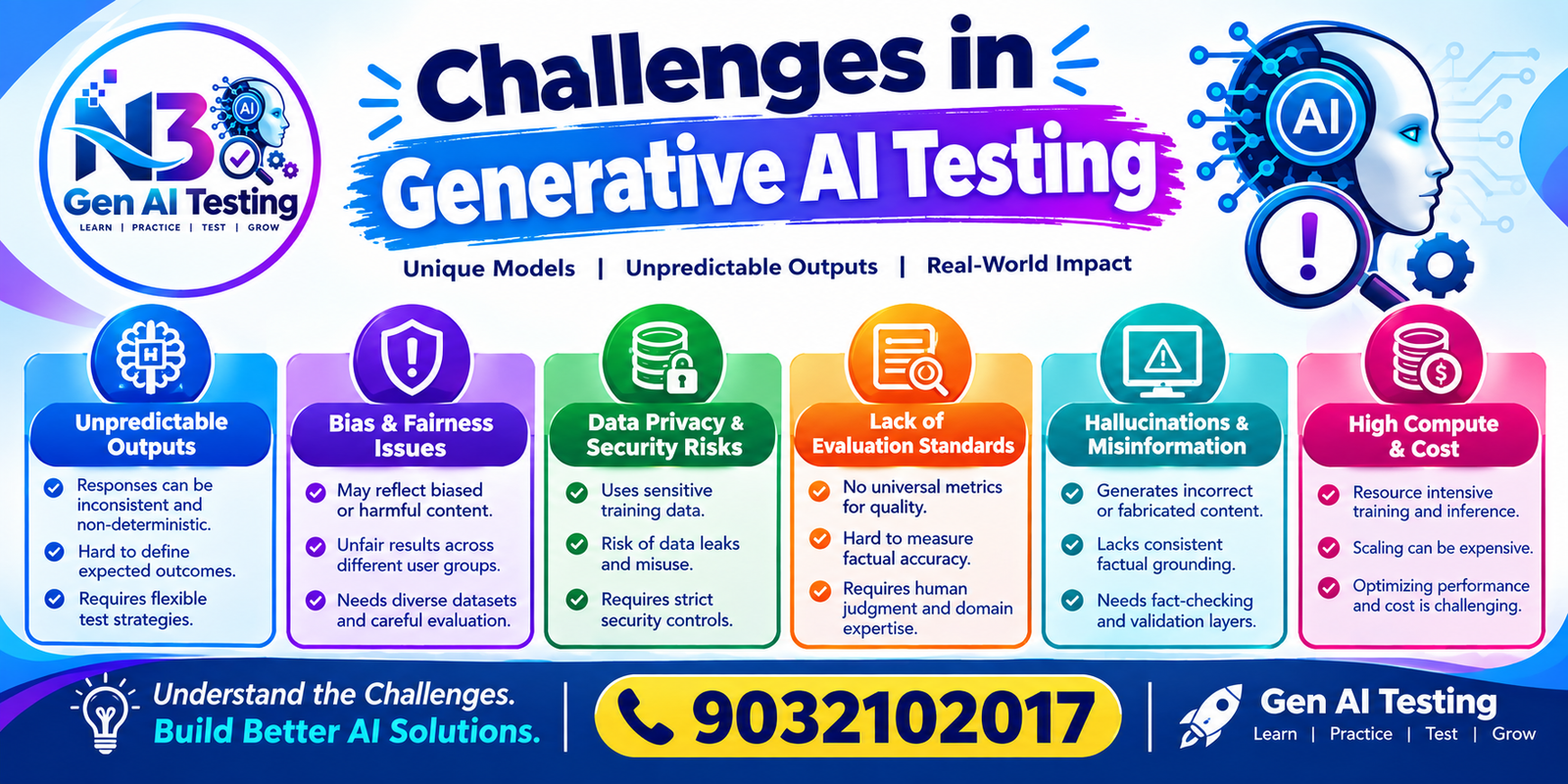
The first unavoidable major hurdle in Generative AI QA Testing is that for the same input, an AI model may produce several completely different results. When we tested traditional software in the past, the results obtained were generally deterministic and predictable. We could calculate in advance what output would correspond to a given input, making verification very simple.
But generative AI is different. It can output multiple entirely valid answers, each of which meets the requirements, making it impossible to lock in a single standard answer in advance. This requires testers not to only focus on pre-written preset results and insist that the AI’s output must perfectly match the preset content. Instead, they must rely on a set of general quality standards to judge whether an answer is qualified one by one.
Hallucinations And Incorrect Information
The next issue to guard against is hallucinations and incorrect information generated by AI. The “AI hallucinations” mentioned here refer to content output by generative AI systems that appears persuasive, logically coherent, and professionally worded, so that anyone would think it is problem-free at first glance.
In reality, however, the content is either inaccurate or completely fabricated from start to finish, with no basis to support its claims. Identifying these deeply hidden hallucinatory contents is a major challenge for AI testers. Testing teams cannot simply rely on manual reviews.
Bias And Fairness
The last loophole to seal is the potential bias and fairness issues that may exist in the model. Generative AI models sometimes output biased or inappropriate content. Tracing the root cause, the problem lies in the fact that such undesirable patterns already exist in the training dataset. After learning these patterns, the model will bring the biases into its own outputs.
Security Risks
Generative AI tools may bring brand-new security threats that have never appeared in traditional software. The rules of ordinary software are mostly locked in by code, making it difficult for users to bypass them with a few words. But generative AI works by understanding the user’s input instructions, which creates an opportunity for people with malicious intent.
Performance And Scalability
For generative AI applications to operate normally as expected, they need to consume a large amount of dedicated computing resources.
If any link cannot keep up, the user’s experience will be compromised. Average response latency, peak concurrent users, token consumption per request, the carrying capacity of the underlying cloud infrastructure, and the call frequency limits of third-party API will all reduce the application’s performance in actual use.
Learn Generative AI Testing
Learning these technologies will give you the ticket to enter this emerging field. The Generative AI Testing Training in Ameerpet covers core content including AI application testing, prompt testing, chatbot testing, automation, performance testing, security verification, and AI quality assessment. You can learn everything from basic operations to advanced skills.
This practical AI Testing Course in Hyderabad is especially suitable for the following groups: software test engineers, quality assurance (QA) specialists, automation development engineers, and technical practitioners who want to expand their skills and enter the generative AI field. Whether you are a newcomer to the industry or a veteran with relevant foundations, you can obtain the knowledge you need from it.
Conclusion
In conclusion, the challenges faced by Generative AI Testing are far more complex than those of traditional software testing. After all, AI systems themselves are dynamic, their outputs have probabilistic properties, and they can generate diverse content, which is completely different from the fixed output logic of traditional software. Simply copying the testing methods of traditional software will not work.
Address: Flat 507, 5th Floor, Annapurna Block, ADITYA ENCLAVE, Kumar Basti, Ameerpet, Hyderabad, Telangana 500038