Manual Testing vs. Generative AI Testing
Today, the software testing industry is changing at an increasingly rapid pace, and AI has been embedded in all kinds of modern applications, development processes, automation platforms, and core links of quality assurance.
Even as new testing directions keep emerging, Manual Testing remains the core cornerstone for ensuring reliable software quality. For learners in Hyderabad who are comparing these two testing directions, only by first understanding their Key Difference can they choose a training course that aligns with their long-term career goals and find a career development path that suits them.
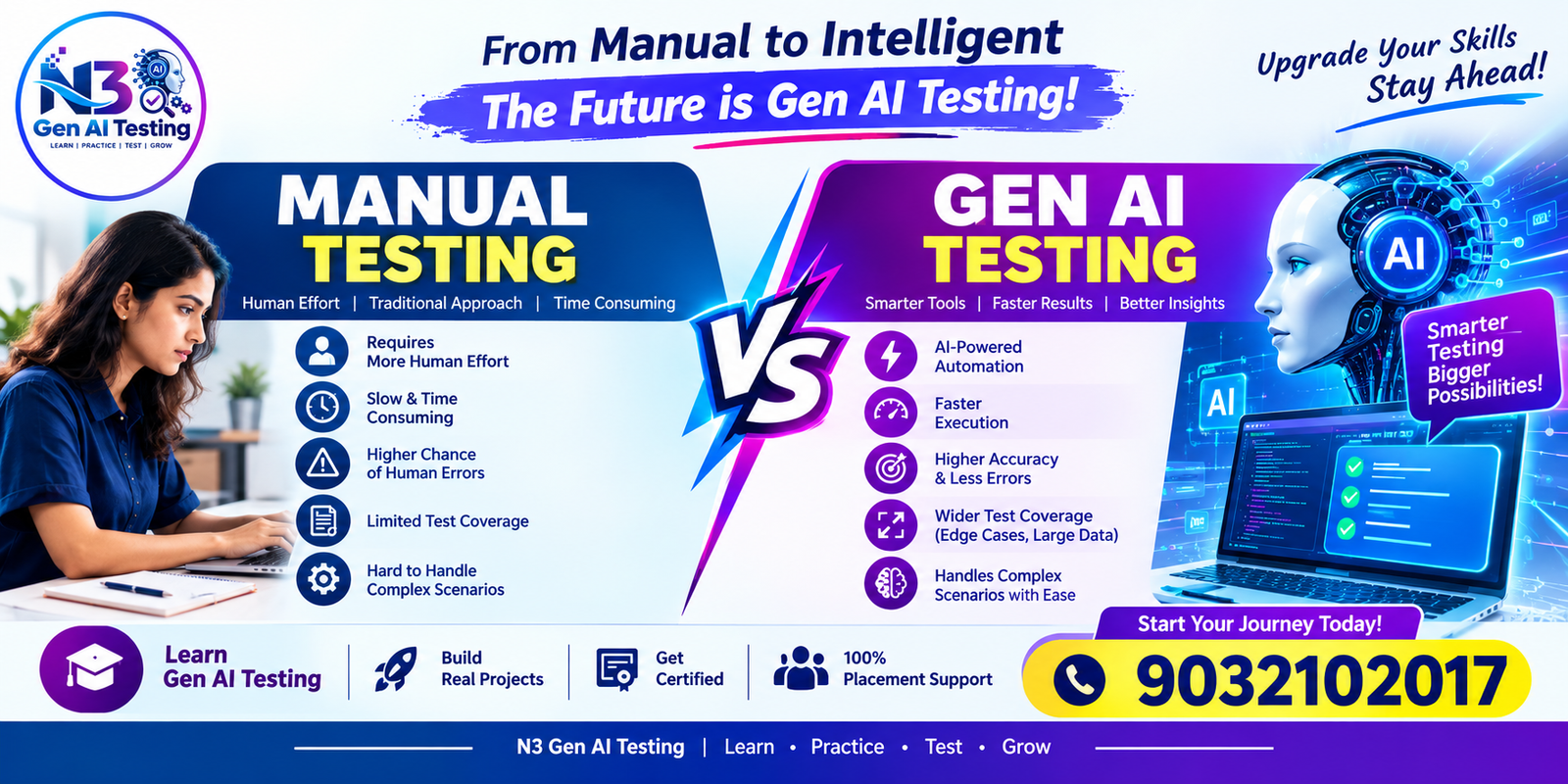
Core Manual Testing Activities
The core work that Manual Testing engineers usually handle includes:
- Requirement analysis
- Test scenario setup
- Test case writing
- Test case execution
- Functional testing
- Regression testing
- Smoke testing
- Usability verification testing
- Exploratory testing
- Vulnerability identification
- Issue reporting
- Test document organization
Manual Testing plays an irreplaceable, unique value in these scenarios. For newcomers in Hyderabad who are just entering the software testing industry, mastering the fundamentals of Manual Testing solidly will allow them to build a stable capability framework.
What Is Gen AI Testing?
Generative AI systems are different: different input prompts, changes in conversation context, differences in the underlying model architecture, adjustments to training data, and various other dynamic factors will all lead to completely different outputs. There will never be a fixed result where the same input produces the exact same output twice. To test such special systems, the evaluation methods in traditional testing frameworks are insufficient. A complete set of additional evaluation methods must be added to identify all potential problems of the AI.
Key Gen AI Testing Quality Indicators
- Response accuracy
- Content relevance
- Output consistency
- Context comprehension
- Ease of use
- Reliability
- Operational performance
- Security
- Performance triggered by prompts
- Unexpected responses outside the expected range
- Quality of AI-generated content
To work in Manual Testing, one must have a comprehensive and solid understanding of the core foundations of software testing. Testers need to be able to analyze project requirements, write rigorous test cases, execute tests thoroughly, articulate the vulnerabilities they find, and complete all common types of functional testing.
These basic capabilities are indispensable for working in any testing direction. Gen AI Testing is built on top of these basic testing capabilities. Mastering only traditional testing content is completely insufficient to work in Generative AI Testing in ameerpet.
Priority Skills for Gen AI Testing
The most priority skills to master for Gen AI Testing include:
- Generative AI fundamentals
- Prompt engineering concepts
- Prompt testing
- AI response evaluation
- Test scenario design
- AI quality assessment
- API testing
- Automated testing
- AI-assisted QA
- Security and reliability assessment
This capability framework shows that learning Gen AI Testing does not require discarding previous Manual Testing experience. There is no need to think that learning new content means completely replacing old knowledge. With the original foundation, learning new AI testing skills will be much faster and understood more thoroughly.
Tools Used in Manual Testing and Gen AI Testing
Manual Testing engineers use a range of general-purpose tools to manage test cases, track vulnerabilities, organize requirements, and streamline the end-to-end testing process, eliminating the need to manage all testing-related content purely through handwritten notes. Testers at different companies and on different projects may use test management systems, vulnerability tracking platforms, API testing tools, browser developer tools, and other common QA technologies. Which specific set of tools is used depends entirely on the company’s project habits and needs. The old original tools are insufficient; new professional tools must be added to complete testing tasks.
Modern AI-Focused QA Tools
Today’s modern AI-focused QA training courses usually teach students to use these tools:
- Selenium
- Playwright
- Testim
- Applitools
- Mabl
- API testing tools
- Generative AI platforms
- Prompt evaluation methods
Why Learn Gen AI Testing in Hyderabad?
Hyderabad has a large, vibrant tech ecosystem that gathers a large number of enterprise software companies, global IT service organizations, fast-growing startups, and hundreds of thousands of tech practitioners. It is the local core of the tech industry, with abundant job opportunities and concentrated training resources. For anyone who wants to study IT or find an IT-related job in Hyderabad, these areas are the most concentrated options.
AI Testing Training in Ameerpet
- The depth of the course syllabus
- The intensity of hands-on training
- The professional experience of instructors
- Opportunities for capstone projects
- Supporting tools
- Flexible class schedules
- Post-graduation employment support
These factors can help learners pick the course that best suits them.
The core criteria for choosing a training course are always the quality of the training and its alignment with actual work.
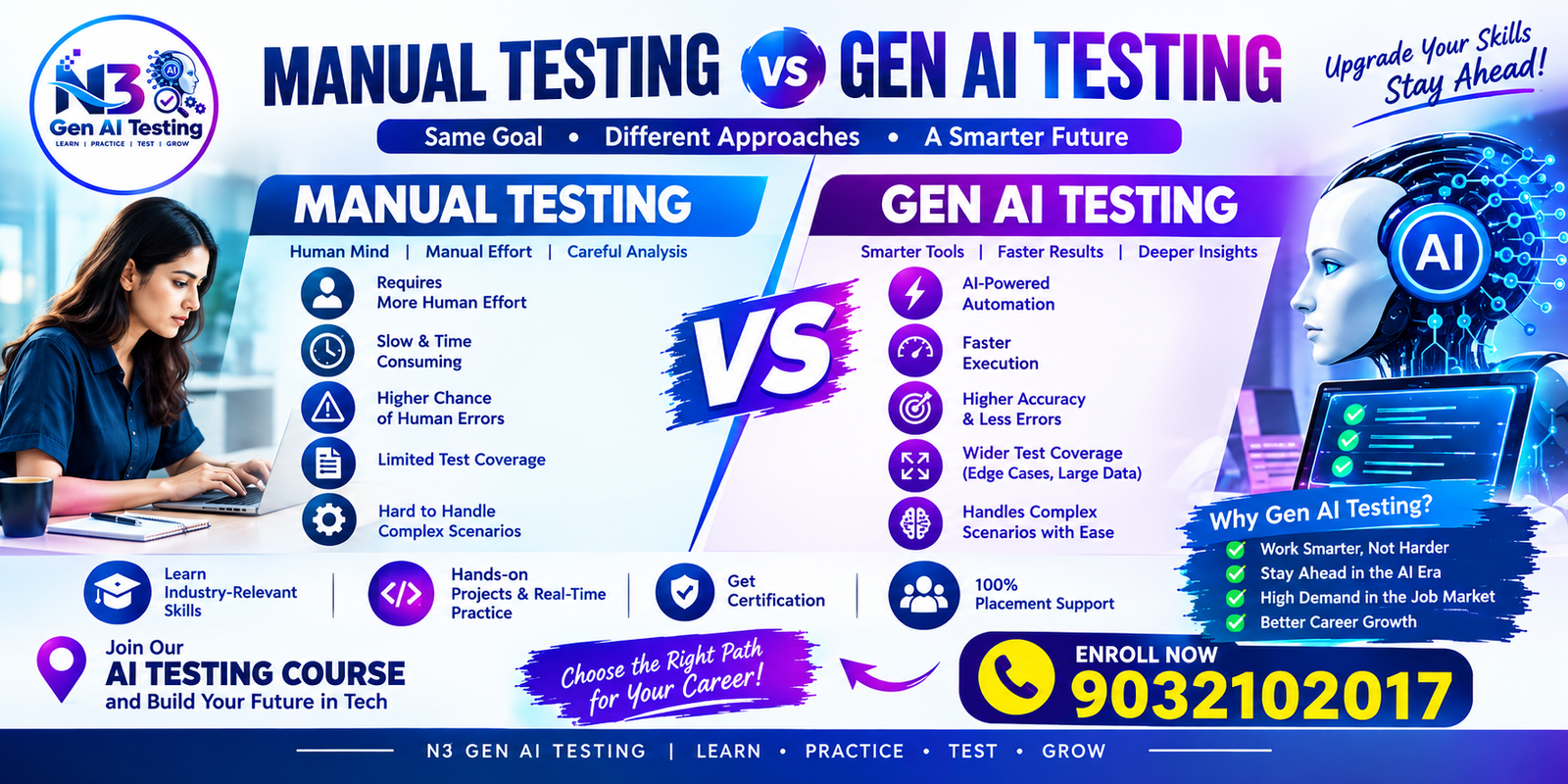
Career Scope
- Manual Tester
- Software Test Engineer
- QA Tester
- QA Analyst
- Software QA Engineer
- Automation Test Engineer
- QA Automation Engineer
- AI Tester
- AI Test Engineer
- Generative AI Tester
- AI QA Analyst
- SDET
These positions offer higher salaries and stronger competitiveness, are cutting-edge directions in the testing industry, and have a large talent gap. The quality of long-term career opportunities depends on the depth of an individual’s technical capabilities, professional experience, project history, interview performance, and the specific requirements of each recruiting company. Learning a certain direction does not guarantee you will get a good job; capability and fit are the core. It is equivalent to learning an additional skill on top of your original foundation, not discarding your original skills to replace them with new ones.
Which Is Better: Manual Testing or Gen AI Testing?
There is no universal answer to this question.
The choice that suits you depends entirely on your current skill level and your long-term career goals.
There is no absolute good or bad, only suitability.
For Working Professionals
For working professionals in Hyderabad, combining their existing testing experience with knowledge of Gen AI Testing is a practical and efficient way to update and expand their technical capabilities. They do not need to quit their jobs to learn new content from scratch; they can supplement new skills based on their original foundation. You will never truly learn how to do testing just by listening to online courses and memorizing knowledge points. The testing process in real work has many differences from what is written in textbooks, and you only know how to handle it after doing it yourself.
Practical Testing Activities
Learners must have the opportunity to:
- Write test cases
- Run test scenarios
- Find vulnerabilities
- Evaluate application performance
- Do API testing
- Practice automation workflows
- Complete project assignments consistent with real industry work
These activities help turn the theories they have learned into practical operations.
- Designing custom prompts
- Evaluating AI-generated responses
- Building diverse test scenarios
- Checking response consistency across different scenarios
- Identifying unexpected performance in applications that exceeds expectations
Only through hands-on practice can you master the judgment criteria; you cannot learn how to evaluate AI outputs by memorizing textbooks.
What to Look for in an AI Testing Course
- Solid software testing fundamentals
- Generative AI concepts
- Prompt testing
- AI application testing
- Automated testing
- API testing
- Hands-on practical assignments
- Real-time or project-based training
- Industry-aligned testing tools
- Interview preparation
- Resume guidance
- Long-term employment support
Conclusion
The entire industry is updating alongside the development of AI technology, and testing methods and requirements are changing. This discussion is a microcosm of that industry change. Manual Testing remains an irreplaceable foundation. It is indispensable for learning QA, test design, vulnerability identification, and core application performance. These new skills did not exist in original Manual Testing, and were created to adapt to new forms of software. The integration of the two is the major trend. No matter how the industry changes, you will be able to stand firm and have long-term development space.
Address: Flat 507, 5th Floor, Annapurna Block, ADITYA ENCLAVE, Kumar Basti, Ameerpet, Hyderabad, Telangana 500038