Ask any QA lead what keeps them up at night, and you’ll hear some version of the same thing: coverage always costs time, and time is the one thing nobody has enough of. For years that trade-off just felt like the cost of doing business. Write more test scripts, hire more testers, or live with gaps. Generative AI is now messing with that equation, which is why the comparison between Gen AI testing and traditional software testing has become more than a theoretical debate.
Strip it down and the difference is fairly blunt. Traditional testing needs a person to sit down and write every scenario by hand. Gen AI testing lets the AI generate, run, and in a lot of cases repair its own tests. That sounds like a minor technical distinction until you notice what it does to release speed, QA budgets, and how much slips through the cracks unnoticed.
We’ll walk through where these two approaches actually diverge, why the gap is worth caring about, and where each one still has real limits.
Where the Line Actually Sits
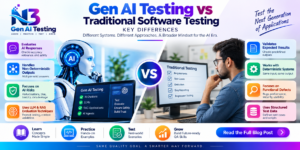
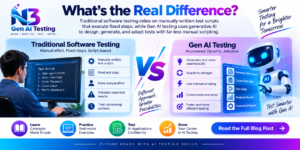
If you want the one-sentence version: traditional software testing relies on manually written scripts that run fixed steps every time, while Gen AI testing uses generative AI to design, generate, and adjust tests with much less manual scripting involved.
A traditional automated test does exactly what someone coded and not one thing more. Move a button, and the script breaks — someone has to notice, fix it, and re-run everything. Gen AI testing takes a different route. Hand the model your requirements or a user story, and it drafts the test cases on its own. When the app shifts underneath it, plenty of these tools catch that and adjust the test instead of just failing and waiting.
The short version: traditional testing runs what a human already designed. Gen AI testing lends a hand with the designing too.
Why Anyone Should Care About This Comparison
Release cycles keep getting tighter, and manual testing simply hasn’t kept up. That’s really the whole reason this comparison matters beyond the classroom.
Test suites that used to eat up weeks now come together in a matter of hours. Manual grunt work drops off sharply, which frees testers to spend time thinking about risk instead of typing out the same boilerplate steps for the fifth time this month. Coverage tends to widen too — AI doesn’t get bored after the hundredth login form the way a human tester does. And fewer broken tests every sprint means the QA budget actually shrinks instead of quietly ballooning. Teams looking into the importance of Gen AI testing usually arrive at this exact math, and it’s a hard argument to wave off.
If your team wants a deeper breakdown of that cost-and-speed case, our Gen AI testing training in Hyderabad covers it in more detail.
What’s Actually Happening Behind the Scenes
A few techniques do the heavy lifting here.
Test cases get drafted straight from requirements or user stories — you feed the model context, and it writes scenarios on its own. Synthetic test data generation solves a real headache: realistic-looking data without dragging actual customer records into a test environment. Self-healing scripts are probably the most satisfying part for anyone who’s spent a Friday afternoon fixing broken locators — the tool notices the UI moved and patches the test itself. Visual and UI testing catches layout shifts that a purely functional test would sail right past. And natural language to script conversion means a tester can describe a scenario in plain English and walk away with working code.
None of this comes standard with traditional testing. Every one of these steps has to be built by hand, every time.
Where Each Approach Actually Gets Used
Regression testing is where Gen AI testing shines the most obviously — old functionality gets re-checked without rewriting scripts every single release. API testing improves too, since a spec can turn directly into request-and-response scenarios without much manual translation. LLM and chatbot testing is genuinely difficult to do well by hand, which is part of why AI-driven evaluation has practically become the default there. Exploratory testing gets a nice boost from AI suggesting paths nobody thought to script. That said, traditional testing still holds its own for simple, stable applications that rarely change — there’s just less to break.
What You Actually Gain
Gen AI testing generally wins on speed, scale, and coverage, and self-healing scripts mean far fewer flaky failures dragging down your CI pipeline. Maintenance overhead drops noticeably compared to the old model. Traditional testing still has one card to play, though — predictability. A script does exactly what it was told, every single time, and some regulated industries genuinely prefer that rigidity over adaptive behavior.
The Honest Downsides
None of this is flawless, and it’s worth saying so plainly. AI models hallucinate sometimes, meaning a generated test can look perfectly valid while not actually matching how your app behaves — someone still needs to check the output before it hits a pipeline. A lot of the tooling in this space is genuinely new, so expect some inconsistency depending on what platform you pick. And feeding sensitive data into a model to generate tests raises real privacy questions that need answering before you start, not after. Traditional testing sidesteps these specific risks, but it pays for that safety with slower coverage and a heavier long-term maintenance bill.
Tools Worth Knowing
Broadly, you’ll run into AI-augmented test automation platforms, synthetic data generators built specifically for QA work, visual testing tools that lean on AI-based comparison, and evaluation frameworks aimed at LLM output specifically. If you want a closer look at how to choose between these, our page on Generative AI quality assurance goes into the practical selection criteria.
A Reasonable Way to Start
Pick something low-stakes first — regression testing is a solid starting point. Keep a human reviewing whatever the AI generates, at least in the early weeks. Track actual numbers: coverage, flakiness, and how much time maintenance eats up, so you know whether the shift is paying off. Give your team room to learn prompt writing and how to sanity-check AI output critically. Then expand gradually into API, UI, and eventually LLM-specific testing once the basics feel solid.
Where This Leaves You
Gen AI testing versus traditional software testing isn’t really a fight either side has to win outright. Traditional methods still make sense for stable, low-change systems that rarely need updating. Gen AI testing fits fast-moving, complex, AI-driven products far better. Most teams end up running both side by side rather than picking one and walking away from the other.
If you want a structured path into this skill set, explore our Gen AI testing course and see where your team’s QA process could use the biggest upgrade first.
N3 Gen AI Testing Course
 Phone: 90321 02017