The Business Case, Explained
Most engineering leaders in Hyderabad have already felt the squeeze. Product teams want to ship weekly, sometimes daily, and QA is expected to keep pace without doubling headcount. That gap is exactly why generative AI testing has moved from a conference buzzword to a real line item on QA roadmaps. It isn’t about replacing testers with a chatbot. It’s about closing the widening gap between how fast software gets built and how thoroughly it gets checked before release. This post walks through why Gen AI testing has become genuinely important, not just trendy. It covers what teams gain, and what they risk, by adopting it.
Why Is Gen AI Testing Important? (Quick Definition)
Gen AI testing matters because it lets teams generate test cases, synthetic data, and adaptable scripts using AI models. That cuts the manual scripting bottleneck that has slowed QA for decades. Traditional automation only runs what a human already wrote, line by line, exactly as coded. Generative AI testing can draft new scenarios on its own. It adjusts when a UI changes, and takes instructions in plain English instead of rigid syntax. That difference turns it from a nice-to-have into something closer to a necessity for teams under real release pressure.
The Business Case for Gen AI Testing
Faster release cycles are the obvious driver. When a model can draft dozens of test cases from a single requirement document, teams stop trading thorough testing off against speed. Manual effort drops too, freeing testers to focus on judgment calls a machine still can’t make well. Coverage improves in a way that’s easy to underestimate: human testers, however experienced, mostly retest the paths they already know. AI-generated tests surface scenarios nobody thought to write down. Cost savings compound over time too. Fewer production bugs mean fewer emergency fixes, fewer angry customer tickets, and less time firefighting instead of building.
How Gen AI Testing Works
None of this happens through one single trick. AI-generated test cases come from feeding requirements or existing code into a model that drafts relevant scenarios on its own. Synthetic test data generation solves a separate, quieter problem — producing realistic, privacy-safe data without touching a real customer record. Self-healing scripts notice when a UI element shifts and adjust automatically instead of breaking the whole suite. Visual and UI testing tools apply similar models to catch rendering issues across devices. Natural-language-to-test-script conversion lets someone describe a scenario in plain English and get back something that actually runs.
Where Teams Are Applying It
Regression testing benefits most visibly. AI can regenerate and re-prioritize suites as an application evolves, instead of testers manually maintaining a growing pile of scripts. API testing speeds up too, because a model can infer test cases straight from a schema. Chatbot and LLM output testing is a newer use case, and it’s a genuinely different skill. Judging whether a response is accurate, safe, and on-brand takes more nuance than checking whether a button click worked. Exploratory testing and rapid test-data generation round things out nicely. Both areas lean on AI’s knack for producing variety on demand.
What You Actually Gain
The clearest gains are speed and scale. Work that used to take days now takes hours. Coverage improves because the model isn’t boxed in by what one tester remembers. Flaky tests, a long-running headache in traditional automation, drop noticeably once self-healing scripts enter the picture. That alone trims the maintenance load that quietly eats up so much of a QA team’s week.
The Trade-offs Nobody Should Skip
This isn’t a free upgrade, and treating it like one causes real problems later. Generated tests can hallucinate — producing a case that looks plausible but doesn’t match how the application actually behaves. Human review stays essential; nobody should ship an AI-written suite unchecked. The tooling is still maturing, so results vary more than vendors admit. Data privacy needs real attention too, wherever synthetic data generation touches anything resembling sensitive information.
Tool Categories Worth Knowing
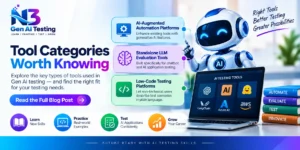
Most teams land in one of a few camps. Some use AI-augmented automation platforms that bolt generative features onto tools they already use. Others reach for standalone LLM-evaluation tools built for chatbot and AI-application testing specifically. A third group leans on low-code platforms that let non-technical staff describe test scenarios in plain language. Which one fits depends on what you’re actually testing, not on whichever vendor markets loudest.
Getting Started Without Overcommitting
Start with one test suite, ideally something repetitive that eats up disproportionate maintenance time. Pilot a single tool there before expanding. Keep a human reviewing every generated test until the pattern of results earns real trust. Measure time saved and defects actually caught, not just how many teams have adopted the tool.
Conclusion
Gen AI testing matters because the gap between release speed and testing thoroughness was already unsustainable. Generative AI is one of the few things actually closing it. If your team is weighing whether to invest in this seriously, or you’re a QA professional trying to build these skills before the market gets crowded, this Gen AI Testing Institute in Ameerpet covers these exact techniques hands-on. That’s a faster path than piecing it together from scattered articles alone.
N3 Gen AI Testing Course
 Phone: 90321 02017