Generative AI Testing Training in Hyderabad
Generative AI Testing Training in Hyderabad helps software testers and QA professionals build practical skills for testing AI-powered applications. The training covers prompt testing, AI response validation, hallucination detection, bias and security testing, test automation, and evaluation techniques for large language models. Learners can gain hands-on experience with real-time projects and industry-focused testing scenarios. The course is suitable for beginners, manual testers, automation testers, QA engineers, and professionals looking to upgrade their skills with Generative AI. With practical training, learners can understand how AI is changing software testing and prepare for emerging opportunities in AI testing and intelligent test automation.
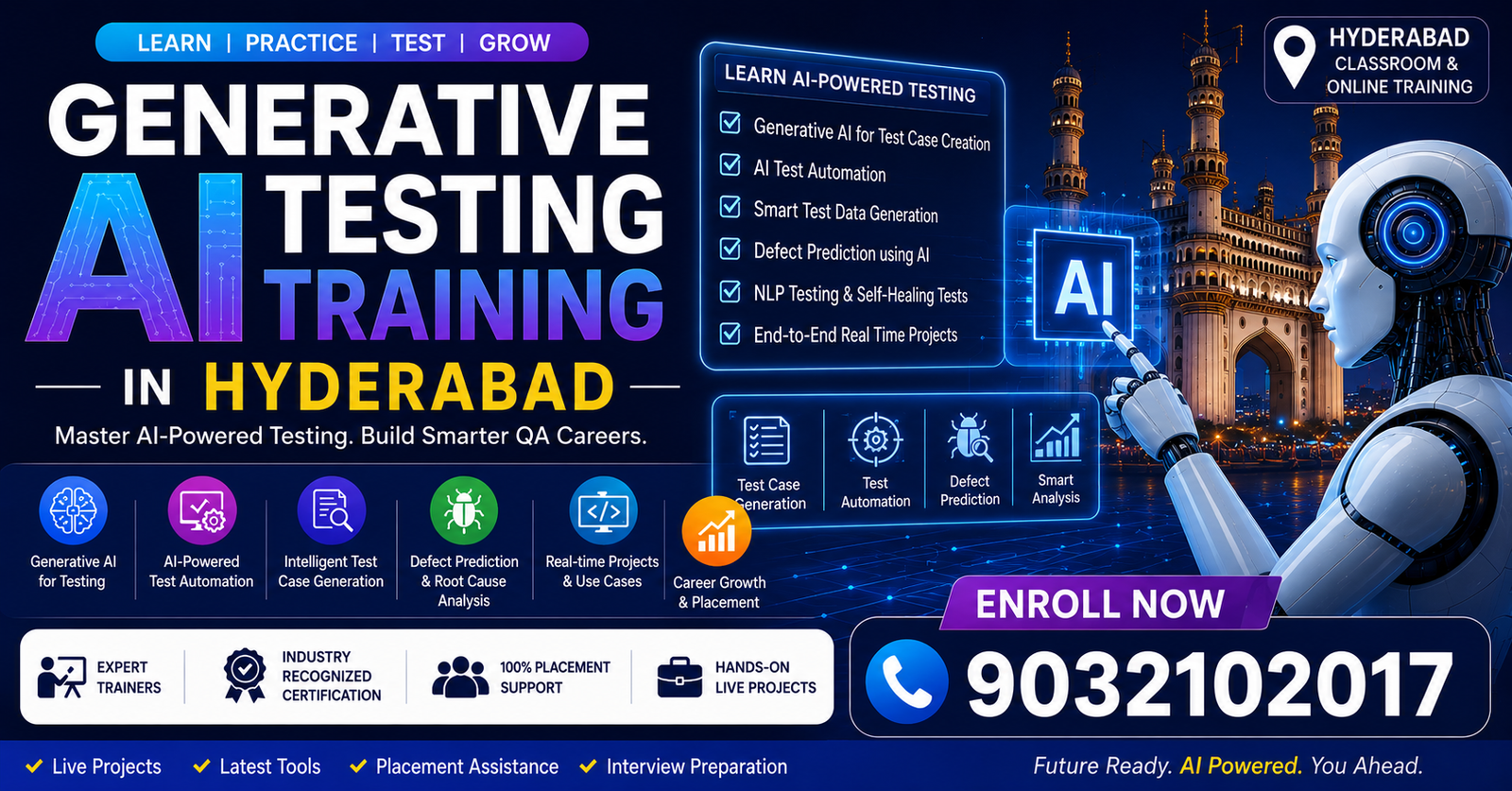
A Generative AI Testing Training course has been launched in Hyderabad. This course is specifically designed for QA practitioners, with a core focus on teaching participants to use modern cutting-edge methods to test applications built with AI—no longer relying on outdated approaches for testing conventional software to handle these new types of products. The course content includes prompt validation, AI output accuracy checks, hallucination detection, bias identification, security testing, performance evaluation, and automation methods for AI testing. Every module is tailored to the unique testing requirements of AI applications, with no vague, generic theoretical content. Participants in this course will not only study textbook knowledge; they will gain hands-on practice in real, operating projects, and access testing scenarios that fully align with actual industry demands. Upon completing the course, they will be able to seamlessly apply what they have learned in class to their daily work, with no disconnect between the knowledge acquired and practical usage.
Generative AI Testing Skills
A Generative AI Testing Training in Hyderabad has been launched for learners new to this field, and the course will teach all the core essential knowledge for testing applications with AI functions. Trainees will learn six specific testing contents, namely prompt testing, response verification, hallucination identification, bias investigation, security inspection, and performance evaluation, each of which is an indispensable practical skill for conducting AI testing. The course does not only focus on theoretical lectures, but also arranges tangible hands-on exercises. By following the steps of the exercises, trainees can first fully understand the specific performance of AI systems in different scenarios, and after completing the practices, they can develop reliable testing solutions on their own that can be directly applied to real software projects.
Practical AI Testing Projects
The core of this training is to develop real, practical skills. Throughout the program, there will be no empty, theoretical indoctrination. Participants will advance alongside tangible, real-world Generative AI testing projects, learning while operating hands-on. Attendees will not only stay at the stage of listening to explanations. They can directly use ready-made AI applications, and must also write customized test scenarios, then score and identify flaws in the content generated by the algorithm, tracking down all output issues that exceed expectations. In addition, they can run testing processes supported by automated tools, eliminating the need to rely entirely on repeated manual operations.
Career Opportunities in AI Testing
Mastery of Generative AI Testing can help QA engineers, software testers, automation test specialists, and practitioners in other technical fields unlock brand-new career paths. Whether you are a seasoned veteran who has long worked in software testing, or a newcomer who has just entered the tech industry, mastering this specialized skill will give you the stepping stone to access new opportunities.
Now, a growing number of enterprises are beginning to adopt product solutions with AI functionality, and the rollout of such AI-integrated tools and systems across the industry is constantly increasing. As a result, market demand for professionals capable of conducting this type of testing continues to surge. The tasks these testers undertake are straightforward: they concretely examine whether the AI products they handle are accurate enough, reliable enough, free of data breach risks, and smooth to operate. The corresponding attributes they need to evaluate are the product’s accuracy, reliability, security, and performance.
Prompt Testing for AI Applications
To conduct testing for Generative AI, the first step is to solidly complete the testing of prompts, which serves as the starting point of the entire testing work. Anyone learning this skill must first thoroughly grasp two core matters. First, they must understand how different prompts affect the final content generated by AI; even subtle differences in the wording of a prompt can lead to vastly divergent results. Second, they must learn how to identify problematic content from the output of AI—this includes inaccurate content that does not align with facts, irrelevant content that does not meet requirements, and contradictory content with inconsistent statements throughout. Relevant training will cover all these practical details, teaching how to adjust different phrasings of prompts, how to anticipate and handle rare extreme scenarios, how to compare and troubleshoot multiple different outputs generated by AI, as well as practical techniques for verifying whether output content is qualified. Once a testing staff member has mastered all these skills, they will be able to design more comprehensive testing scenarios. This not only allows them to carry out testing work more solidly, but also improves the reliability of applications with AI functions during the testing phase, making the performance of these applications more stable.
Hallucination and Accuracy Testing
Current AI systems occasionally output erroneous information, and even mislead people down the wrong path. Such unreliable outputs, if applied in study, work, or daily life scenarios, could cause serious trouble. For this reason, conducting accuracy checks on their output content is indispensable—it is not an optional extra step, but a core prerequisite to ensure that AI can be used properly and deliver good performance.
AI Test Automation Techniques
To efficiently test Generative AI applications, automation is an unavoidable core priority. Simply put, Generative AI applications are those AI programs that can write copy and draft blueprints, while automation refers to having machines replace humans to complete fixed, repetitive tasks, eliminating the need for people to stay on site to perform manual operations step by step. This approach helps us identify flaws in AI programs faster and more smoothly, and it plays a critical role across the entire testing workflow.
Real-Time Generative AI Testing Projects
Learn through hands-on practice with real-time projects: instead of memorizing knowledge points from textbooks, you will advance alongside the actual progress of projects with real, practical tasks, gain tangible and useful experience, and truly apply the concepts of Generative AI testing to practical scenarios. The experience you build this way is not an empty framework; it can be applied directly in real work.
Address:
Flat 507, 5th Floor,
Annapurna Block,
ADITYA ENCLAVE,
Kumar Basti,
Ameerpet,
Hyderabad,
Telangana 500038
phone number: 90321 02017